REVIEW · MOAB
2 hour Moab Ebike Petroglyph Tour
Book on Viator →Operated by Pedego Moab · Bookable on Viator
Carved stone stories ride with you. This 2.5-hour Moab e-bike petroglyph tour from Pedego Moab pairs quiet river-edge scenery with two meaningful rock-art stops, so you get context, not just photos. You meet at 1076 S Main St at 8:00 am, then pedal with electric help as you search for marks made thousands of years ago.
I especially like the small group size (up to 12 people) and the fact the petroglyph stops come with free admission tickets. That combination keeps the experience feeling personal and keeps the price from turning into surprise extras.
One thing to consider: the ride includes bumpy gravel and sand, and the return can feel a bit exposed for anyone who dislikes fast, rough downhill sections. If you’re nervous on uneven surfaces, tell your guide right away so you ride at your comfort level.
In This Review
- Key highlights you’ll care about
- What you’re really signing up for in Moab
- Meeting at Pedego Moab: timing and what to plan for
- Moonflower Canyon: river-edge petroglyphs and how to read them
- The Birthing Scene: cliffside rock art and the meaning-building view
- E-bikes on gravel and sand: comfort, control, and safety
- How the guides turn petroglyphs into a story you remember
- Price and value: $117 for two petroglyph stops on e-bikes
- Who this Moab petroglyph e-bike tour fits best
- Should you book Pedego Moab’s petroglyph e-bike tour?
- FAQ
- Where does the tour start?
- What time does the tour begin?
- How long is the tour?
- How much does it cost?
- Is the tour admission included for the petroglyph stops?
- What language is the tour offered in?
- How big is the group?
- Are service animals allowed?
- What if the weather is poor?
- What is the cancellation window?
Key highlights you’ll care about
- Moonflower Canyon + Birthing Scene: Two dedicated petroglyph stops, each with about 15 minutes to look up close.
- River-border context: The route follows a river corridor tied to how prehistoric people used the area.
- E-bike control for first-timers: You can use assist power (levels plus a throttle) rather than relying on leg strength.
- Stops built for viewing and stretching: Plan on multiple short breaks during the ride.
- Local guides with real Moab focus: Names you may meet include Ron, Hayden, Khaden, and Andrew.
- Fat-tire stability on rough ground: Many people find the bikes make gravel and sand feel manageable.
What you’re really signing up for in Moab
This is a guided, story-first e-bike outing aimed at petroglyphs in two focused locations. The schedule is tight enough to feel like a real adventure, but not so long that your body or attention has to last all day.
At $117 per person, you’re paying for three things at once: the e-bike experience, guided interpretation, and access to petroglyph stops that include admission tickets at no extra charge. In Moab, that’s often the difference between wandering and actually understanding what you’re seeing.
You’ll also be riding with a max group size of 12, which matters more than people think. Smaller groups let the guide watch spacing, help with bike fit, and keep the conversation going while you’re stopped.
Meeting at Pedego Moab: timing and what to plan for
The tour starts at 8:00 am at 1076 S Main St, Moab, UT 84532, and it ends back at the meeting point. The total time runs about 2 hours 30 minutes (approx.), so it slots neatly into a morning plan when the sun is still friendly.
You’ll get a mobile ticket, and you’ll receive confirmation at booking time. The tour is offered in English, and service animals are allowed.
What I’d plan around: bring a bit of water and sun protection. Even with e-bike help, you’re outside for a few hours and you’ll be stopping to look at stone carvings up close. One of the most repeated practical notes from people who’ve done it: pack light but don’t show up dry—a small backpack for water and a hat + sunscreen go a long way.
Moonflower Canyon: river-edge petroglyphs and how to read them
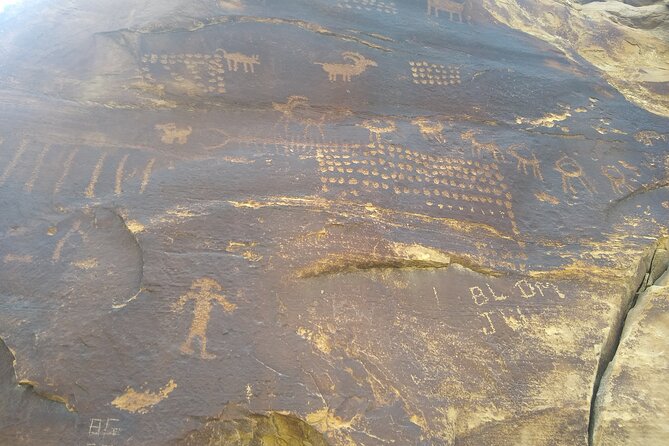
Your first stop is Moonflower Canyon, and it runs about 15 minutes. This is not just a scenic pull-off. The big value here is that the guide frames the petroglyphs as part of a lived landscape—specifically the river corridor tied to prehistoric people who treated the water as a kind of boundary.
When you arrive, use that short time like it’s a mini museum visit: pause, look, then look again. Petroglyphs can feel subtle at first, especially when you’re scanning from a distance. With guidance, you get pointers on what to notice—carving style, placement, and the ways these marks relate to the route and the setting.
Two things this stop does well for you:
- It teaches you to stop searching for one famous panel and instead notice clusters and patterns.
- It gives you context so the carvings don’t feel random or decorative.
A realistic note: you’re riding in between views, so your eyes will have to switch from motion to careful looking. That’s why the short, timed stop works. You get enough time to see, without losing the group or the story arc.
The Birthing Scene: cliffside rock art and the meaning-building view
Your second stop is the Birthing Scene, also about 15 minutes. It’s described as a rock-art scene on a huge boulder high on a cliff, near a road that now passes. That detail matters because it changes your perspective: you’re seeing ancient work placed in a dramatic spot that people would have needed to notice from below or from the approach routes.
This is where the guide’s narrative really counts. The value isn’t that someone tells you a single final answer. It’s that you learn how people think about these carvings: as messages, symbols, and stories left behind in stone.
Expect to spend time looking upward and then around. The scene’s placement can make you appreciate the relationship between the art and the travel route. Even if you’ve heard about famous petroglyph areas in Moab before, this kind of stop tends to widen what you see: you start connecting new panels to older ideas about how the land was used and understood.
One practical consideration: the ride leading to and from cliffside viewpoints includes uneven ground. The good news is you’re not hugging the cliff edge. The recurring advice from people who’ve done this is that the route keeps you away from the scariest drop-offs, but you still feel the terrain. If that’s your worry, stick to the pace you’re comfortable with and let the guide know during bike setup.
E-bikes on gravel and sand: comfort, control, and safety
This tour lives in the real world: bumpy gravel, occasional sand, and grade changes. The e-bike side makes the whole thing doable for more people than a traditional pedal-only ride would.
From people’s experiences, a few setup features help:
- You can use multiple power levels and a throttle, so you’re not stuck constantly grinding uphill.
- You don’t have to pedal hard all the time. Assist can do the work when surfaces get slower.
- The bikes are fat-tire style, which tends to make traction feel more forgiving on loose ground.
If it’s your first time on an e-bike, don’t panic. The best practical move is simple: ask the guide to help you get comfortable with how the controls work before you start moving fast. People mention that once you understand the plus/minus button and how assist responds, the bikes feel much easier on rough surfaces.
Footwear and sun matter more than you think. Bring good sneakers you can trust on gravel, and consider that you might need to dismount and stretch during the ride. A short snack and water can help too, especially in hot months.
Safety is a real theme here. People talk about the guide checking that everyone has the right-sized bike and keeping an eye on the group. One caution still deserves respect: some riders felt the return downhill on rough ground was a little intense. That’s not a deal-breaker for most people, but it’s a reason to go slow if you’re even slightly uneasy.
How the guides turn petroglyphs into a story you remember
The biggest reason people rate this tour so highly is the human part. Names that show up in the guide lineup include Ron, Hayden, Khaden, and Andrew, and the common thread is enthusiasm plus careful explanations about what you’re seeing and why it might matter.
You’ll notice a style shift: the guide doesn’t just point and move on. They slow the group down at the right moments, connect carvings to the broader area, and talk about tribal migratory patterns and cultural context. Some guides also share personal work and long-term study of the region, which adds a sense of seriousness to the fun.
One small thing that comes up in feedback: if you’re hard of hearing or you like crystal-clear audio, you might appreciate a microphone during biking. Even without that, the guide usually gives repeated chances to hear the story while you’re stopped.
For your decision-making: if you want petroglyphs explained in a way that helps you notice more, this is built for that. If you only want exercise or only want scenery, you may find the route short and the talking portion more than you expected.
Price and value: $117 for two petroglyph stops on e-bikes
Let’s talk value in a straight line.
You’re paying $117, and you get:
- an e-bike experience for the full ride window
- bike fitting and safety guidance
- admission tickets included for the petroglyph stops
- a guide who teaches you how to see what’s carved into stone
In Moab, people often spend time and money trying to piece together self-guided routes. Here, the structure does the work for you. The guide brings the interpretation and helps you locate petroglyph sites you might miss on your own, even if you’re familiar with Moab from other stops.
The main reason some people hesitate: the duration is only about 2.5 hours, so it isn’t an all-day deep exploration. One of the recurring “wish it was longer” sentiments is basically: after you get comfortable on the bike and the story hooks in, you want more time. If you like long outdoor days, you may want to pair this with another Moab activity after.
Still, for most visitors, the time window is a plus. You’ll likely feel satisfied rather than wiped out, and you can keep the rest of your day open.
Who this Moab petroglyph e-bike tour fits best
This tour is a strong match if you want:
- a fun way to see petroglyphs without driving to every spot and guessing what you’re looking at
- e-bike riding that feels manageable even for first-timers
- a morning plan with built-in stops and short breaks
It also tends to work well for couples and families. People describe it as safe and suitable for different comfort levels on e-bikes, as long as you follow the guide’s pacing and do the basic prep (water, sun protection, steady shoes).
Where I’d be cautious:
- If you dislike uneven ground or you know you struggle with downhill riding on rough surfaces, consider how you’ll feel during the return.
- If you’re expecting a long-distance ride, treat this as a guided sampler rather than a full day of biking.
Should you book Pedego Moab’s petroglyph e-bike tour?
Book it if you want Moab petroglyphs explained in a way that makes you notice details, and you’d like to do it with electric bike help instead of relying on fitness alone. The small group size, the free admission ticket for the stops, and the repeated praise for guide storytelling are the big wins.
Skip it or choose a different activity if you strongly prefer paved routes only, or you know you get tense on gravel descents. Also, if you only want scenery and don’t care about meaning, the time spent looking and listening might feel like more “talk” than you want.
If you’re on the fence, I’d make this your decision rule: you’re not just paying for a ride here—you’re paying for a way to see rock art that would otherwise be hard to interpret. That’s exactly the kind of value that turns a short morning into a real memory.
FAQ
Where does the tour start?
The tour starts at 1076 S Main St, Moab, UT 84532, USA. It also ends back at the same meeting point.
What time does the tour begin?
The start time is listed as 8:00 am.
How long is the tour?
The duration is about 2 hours 30 minutes (approx.).
How much does it cost?
The price is $117.00 per person.
Is the tour admission included for the petroglyph stops?
Yes. The stops listed include admission tickets marked as free.
What language is the tour offered in?
The tour is offered in English.
How big is the group?
The maximum group size is 12 travelers.
Are service animals allowed?
Yes, service animals are allowed.
What if the weather is poor?
The tour requires good weather. If it’s canceled due to poor weather, you’ll be offered a different date or a full refund.
What is the cancellation window?
You can cancel for a full refund up to 24 hours in advance of the experience’s start time.