REVIEW · BRASILIA
Bike Tour of the 4 Scales of Lucio
Book on Viator →Operated by Camelo Bike Tour · Bookable on Viator
Brasília changes at bike speed. This 7-hour ride strings together the city’s design ideas and real daily life, using a steady set of stops with free admission where listed. I love how the route explains the plan behind the famous buildings while still showing the streets you actually walk in, and the pace keeps you from feeling stuck behind a car window.
One heads-up: you’re on a bike for most of the day, and bike fit or bike condition can be hit-or-miss, so you’ll want to check comfort early and speak up fast if something feels off.
In This Review
- Quick hits: why this Lúcio Costa bike tour works
- Why Brasília’s design makes sense when you ride
- Meeting point and getting comfortable fast
- Torre de Televisão and the craft-fair pass: a strong first orientation
- Clube do Choro: modern design meets real music training
- Convention Center and Parque da Cidade: big-scale planning, on wheels
- Superquadras and church tiles: where the plan becomes personal
- Palace Itamaraty and the religious landmarks: icons with function
- The Metropolitan Cathedral and the street-between-spots idea
- Praça do Povo and Setor Comercial Sul: the city on weekdays
- Sarah Hospitals and Lelé’s approach: human scale in big planning
- Three Powers Square: where the city’s story is written
- Panteão da Pátria and Burle Marx garden: the softer edges
- Culture lanes around Espaço Cultural Renato Russo and the arts district
- Practical value: what you’re paying for (and what to watch)
- Who should book this bike tour
- Should you book Bike Tour of the 4 Scales of Lúcio?
- FAQ
- How long is the bike tour?
- What does the tour cost and what’s included?
- Are admission tickets included for the stops?
- Is lunch included?
- Do I have to wear a helmet?
- What should I do if the weather is bad?
- Can children join the tour?
- What is the cancellation policy?
Quick hits: why this Lúcio Costa bike tour works

- Four Scales of Lúcio Costa, explained by movement: you literally ride the idea, not just hear about it.
- Niemeyer moments with practical context: from the Cathedral to Itamaraty, you get the “why,” not only the “wow.”
- Free-entry stops on a long loop: many sights list tickets as free, which helps make the price feel fair.
- Small group size (max 15): easier turns, easier questions, fewer chaotic crosswalk moments.
- Real culture stops, not only postcards: Clube do Choro, craft fair pass-by, and everyday commercial areas.
- Helmet offered and water included: simple comfort basics handled before you start rolling.
Why Brasília’s design makes sense when you ride
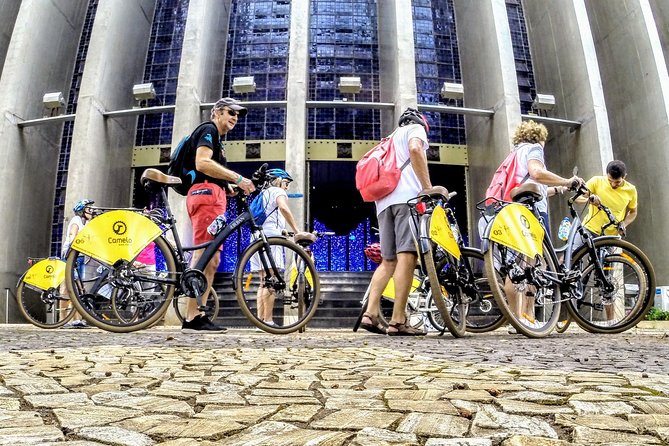
Brasília is one of those cities where the famous architecture is only half the story. The other half is how everything is laid out for walking, commuting, and daily errands. That’s exactly why this bike tour feels different from a straight monument hit.
You start with viewpoints and cultural anchors, then move into residential “superquadra” thinking—those patterned neighborhoods that were designed as functional cells of city life. After that, the route shifts to the civic core: the Three Powers area, Niemeyer’s signature forms, and the long lines of the Esplanade. Riding means you see the scale changes in real time. Long distances stop feeling endless because you’re moving with purpose.
Two practical things also help a lot: the tour runs about 7 hours (so it’s long enough to connect the dots), and it stays small, capped at 15 travelers. When the group is tight, you can actually ask questions at intersections instead of yelling over a crowd.
You can also read our reviews of more tours and experiences in Brasilia.
Meeting point and getting comfortable fast
The tour starts and ends at Camelo Bike Tour Brasília, in Asa Sul, at SHS Quadra 06, Conjunto A, Bloco A, Loja 17 (Centro Empresarial Brasil 21). This location matters because Asa Sul is where a lot of the meaningful riding and most of the monumental sites converge.
You’ll get:
- A bicycle
- Two 500 ml bottles of mineral water
- A helmet offered (helmets aren’t mandatory in Brazil, but using one is still smart)
That “offered” detail is worth your attention. I’d wear the helmet from minute one. It signals that the guide expects real traffic crossings and controlled road behavior, not a lazy pedal around empty paths.
Bike fit is the other big item. One rider feedback you should take seriously: the selection can be challenging for smaller bodies, and someone may need extra time at the start to get comfortable. Do this early. Before you leave the meeting point, check:
- seat height
- reach to handlebars
- how your legs clear while pedaling
If anything feels wrong, say so right away. Fixing fit halfway through a long ride is annoying at best.
Torre de Televisão and the craft-fair pass: a strong first orientation
The first stop is Torre de Televisão (the Television Tower). It’s a logical opener because it gives you a city landmark that helps everything else snap into place. Even if you’ve seen Brasília photos before, being near the tower helps you understand why the city looks the way it does.
What I like here is the rhythm: you’re not thrown into long lectures. You meet, roll out, get a quick orientation stop, and then you’re moving again.
From there, the tour passes by a TV Tower Craft Fair area. Even if you don’t have time to browse everything, the pass-by is a nice reminder that this city isn’t only government offices and award-winning architecture. People shop, snack, and create right alongside the icons.
Clube do Choro: modern design meets real music training
Next comes Clube do Choro, a Niemeyer project that functions as a concert hall for about 500 people. The tour focuses on something important: this isn’t just a pretty building. It’s an active institution, and the choro-school component is a big part of why it matters.
The stop highlights the school’s scale: more than 1,000 students learning instruments that cover cavaquinho, mandolin, tambourine, guitar, saxophone, flute, accordion, harmonica, violin, and viola caipira. That range of instruments is a good clue that you’re not visiting a museum set dressing. You’re visiting a living music pipeline.
A unique detail here: the tour notes that the Clube do Choro stage was later transformed into a kind of “solo sacred” space after Paul McCartney’s surprise, intimate show on November 28, 2023. The comparison given is Liverpool’s Cavern Club style of closeness. Whether you’re a Beatles fan or not, it’s the kind of story that makes the place feel unexpectedly human.
Convention Center and Parque da Cidade: big-scale planning, on wheels
Then the ride brings you by the Ulysses Guimarães Convention Center. This is one of those buildings that helps you understand Brasília’s workflow logic: large-capacity civic infrastructure built near major government areas and major hotels.
The tour points out capacity and footprint—9,400 people at once inside a 54,000 m² space. You also get design context: the original project was by architect Sérgio Bernardes, and the complex sits about five minutes from federal and local government headquarters, with roughly fifteen minutes to the airport.
After that, you head to Parque da Cidade Sarah Kubitschek, described as one of the world’s largest urban parks. That’s a useful balance after so much “hard” civic architecture. It also gives you a breather before the route dives deeper into residential scales and landmark buildings.
Superquadras and church tiles: where the plan becomes personal
One of the most satisfying parts of the tour is how it shifts from monuments to neighborhoods.
You stop at SQS 308 Quadra modelo in Asa Sul. The tour explains that Lúcio Costa designed this model court, with Burle Marx handling urbanism and landscaping. It was inaugurated February 19, 1962. If you’re trying to understand Brasília quickly, this is a big clue: the city isn’t only “buildings.” It’s also the pattern of lots, building projections, and community spaces.
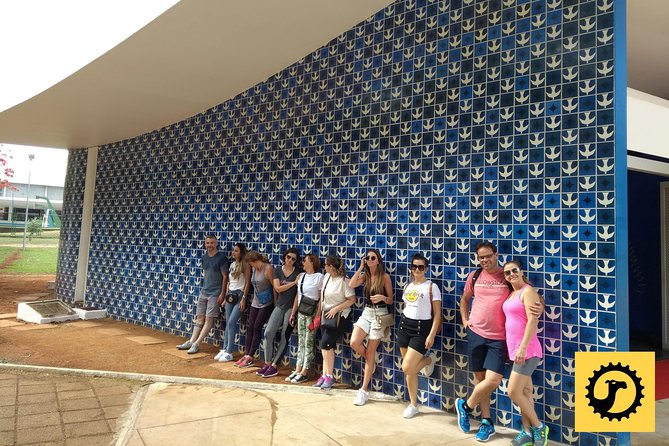
Then you visit Igrejinha Nossa Senhora de Fátima. This church is anchored in the residential sector and tied to Sarah Kubitschek’s request for a grace related to her daughter’s cure. The tour also calls out the exterior tile work by Athos Bulcão, featuring stylized dove and star motifs. Even if you only spend about 20 minutes here, the detail level makes it worth it.
Another neighborhood stop follows with Superquadra Sul 302, explained as sharing the superquadra concept even if it’s not the first one. You get the idea: shops, schools, and leisure areas sit inside a planned residential logic.
The payoff of these stops is that you start to “see” Brasília’s urban grammar. You notice how public space, civic space, and daily living space fit together.
Palace Itamaraty and the religious landmarks: icons with function
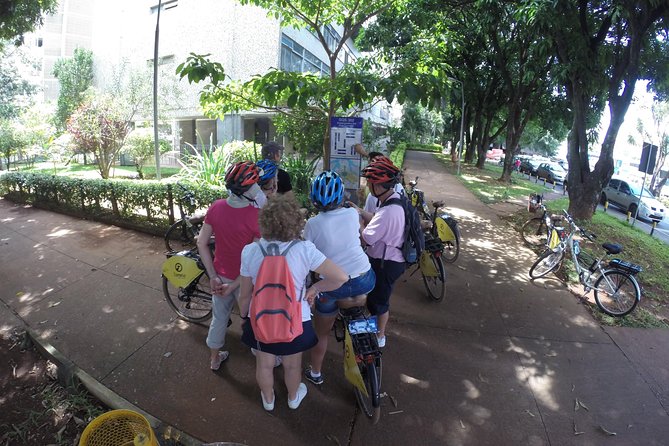
At Palácio Itamaraty (Ministry of Foreign Affairs), you’re at one of Niemeyer’s best-known works, also known as Palácio dos Arcos. This kind of stop can go two ways on a tour: either it becomes a quick-photo exercise, or it becomes a useful way to understand institutional power. Here, the inclusion helps because it sits inside a full route about city scales, not isolated sightseeing.
Then you ride to Santuario São João Bosco, built in honor of Brasilia’s patron saint, St. John Bosco. It’s a shorter stop, but it adds another layer: religion and civic planning show up together in the city’s layout.
The Metropolitan Cathedral and the street-between-spots idea

Next is the Catedral Metropolitana, designed by Oscar Niemeyer. The tour frames it as a milestone for modern architecture and for Brasília’s story. Even if you’ve seen it in pictures before, it hits differently when you arrive by bike, after riding through neighborhoods and smaller-scale civic buildings. You feel the shift in scale.
The tour also includes a pass-through along Rua das Farmacias, a commerce street dominated by pharmacies near the South Medical and Hospital Sector. This detail is small but smart. It’s your reminder that the city’s planning includes everyday needs, not only landmark plazas.
Then you continue onward.
Praça do Povo and Setor Comercial Sul: the city on weekdays
The route touches Praça do Povo in the South Commercial Sector (SCS). The tour notes it was renovated in 2021, with the project recognized in IAB Awards 2021 (Midwest) for Urbanism, Planning and Cities. It also mentions the new functionality: areas for kiosks, spaces for skateboarding, and room for shows.
This is the kind of stop I’d call practical. It helps you see Brasília as something you can use, not only something you can observe.
From there, Setor Comercial Sul gets more time in the story. The tour describes it as central, with major weekday pedestrian flow because it holds services and institutions, and because it connects to the bus station and the Esplanada dos Ministérios area. It also mentions revitalization and the involvement of important architects like Lelé and Oscar Niemeyer.
If you love architecture but also want to feel the “city engine,” this commercial-sector context helps.
Sarah Hospitals and Lelé’s approach: human scale in big planning
One of the more interesting stops in the route is the Sarah Hospitals Network first unit, a rehabilitation center specializing in locomotion and orthopedic diseases.
The tour emphasizes a design approach that reduces the scary feeling many health facilities have. The description is specific: large, airy, multicolored environments with natural ventilation and lighting soften long stays. It also notes a rationalized construction system to distribute installations and allow flexibility inside.
The architect connection matters too. João da Gama Filgueiras Lima (Lelé) is cited as someone who worked with Niemeyer and Lúcio Costa, and who was attentive to construction methods, detailing, and rationalization. If you’re the type who wants proof that “architecture” affects real life, this stop gives it.
Even though this is a bike tour and your time is limited, the design details are enough to change how you think about Brasília.
Three Powers Square: where the city’s story is written
Now you reach the civic climax.
You visit Praça dos Três Poderes, created by Lucio Costa and designed by Oscar Niemeyer, inaugurated on April 21, 1960. This is the large civic space that opened the capital day.
Then the tour goes to Espaço Lúcio Costa, an underground site opened in 1992 for Lúcio Costa’s 90th anniversary. It houses the Brasília Model and the Plano Piloto Tactile Model. That tactile piece is a meaningful detail because it shows the city design process wasn’t only visual—it was also made to be understood by more than one sense.
The tour then includes the Supremo Tribunal Federal (Supreme Federal Court), described as on the third vertex of Praça dos Três Poderes, opposite the Planalto Palace, designed by Niemeyer with an original design contribution from Lúcio Costa.
And then come the cultural and civic “next-door” buildings: the Claudio Santoro National Theatre (noted as one of the most beautiful works in Brasília) and the National Library of Brasilia stop. The tour also references the area where the President dispatches, placing you at the institutional heart of the capital.
Panteão da Pátria and Burle Marx garden: the softer edges
The route doesn’t end at government buildings.
You pass by Panteão da Pátria (Pantheon of the Fatherland), then spend time at Jardim Burle Marx. The inclusion of a garden stop matters because Burle Marx connects modern design to planting and public space—an angle that fits this tour’s whole idea of “scales.”
Finally, you ride along the Ministries Esplanade, which is described as the spine of the area. From a bike perspective, it’s where you can feel how the plan stretches and how space behaves when you’re traveling through it rather than standing still.
Culture lanes around Espaço Cultural Renato Russo and the arts district
The route includes a pass and stops connected to Espaço Cultural Renato Russo 508 South, described as having rooms, galleries, and theaters used for art and cultural presentations in different languages. Two theaters are specifically mentioned: Teatro Galpão and the renovated Teatro de Bolso.
It’s a good pairing with all the civic architecture you see earlier. You get the message that Brasília’s “cultural life” was built into the plan too.
Practical value: what you’re paying for (and what to watch)
At $97.03 per person, the price feels reasonable for what you get—especially because so many listed stops show admission tickets as free. You also get the essentials: bicycle, helmet offered, and two bottles of water.
So the value equation is strong as long as you like a structured day. The trade-off is obvious once you think about it: the stops are short (some are around 5 minutes, others 10–45), so you’re not getting a slow, deep, museum-style pace. This tour is built for getting oriented and seeing the main pieces of Brasília’s design logic.
What can reduce the experience:
- bike fit and bike condition can be uneven, so check your comfort immediately
- lunch is not included, so plan around food timing
- if the ride stretches into evening, visibility becomes a real issue, so ask about helmet or bike lights before you roll if you expect darker conditions
That last point lines up with a specific feedback I’d treat as practical advice: if your tour runs longer than expected and lighting wasn’t planned, it’s a safety annoyance. Ask early, and you’ll ride with less stress.
Who should book this bike tour
This is a strong choice if you:
- want a big-picture understanding of Brasília’s architecture plan, not only the famous monuments
- like riding enough to cover most of a day
- enjoy guided explanations of why buildings and neighborhoods are arranged the way they are
- want a smaller group (max 15) so questions don’t feel awkward
It’s also a good fit for families. There’s an articulated tandem passenger trailer/bike option for children from 4 to 10/12 (ask in advance).
Should you book Bike Tour of the 4 Scales of Lúcio?
Book it if you want the city to make sense through movement. This route is built around the idea that Brasília isn’t random: it’s a planned sequence of scales, from parks and neighborhoods to the civic heart. You’ll come away with better bearings and a clearer story of how Lúcio Costa’s urban logic and Niemeyer’s forms work together.
Skip it (or rethink timing) if:
- you get uncomfortable riding for long stretches
- you need a slower pace with longer museum time
- you’re sensitive to bike comfort and don’t want to spend time adjusting at the start
FAQ
How long is the bike tour?
The tour lasts about 7 hours.
What does the tour cost and what’s included?
It costs $97.03 per person. Included items are bicycle use, two bottles of mineral water (500 ml each), and a helmet offered.
Are admission tickets included for the stops?
For the listed stops, admission tickets are marked as free.
Is lunch included?
No. Lunch is not included.
Do I have to wear a helmet?
Helmets are offered, and the use of helmets is not mandatory in Brazil, but it’s still a good idea to wear one during the ride.
What should I do if the weather is bad?
The experience requires good weather. If it’s canceled due to poor weather, you’ll be offered a different date or a full refund.
Can children join the tour?
Yes. There is an articulated tandem passenger trailer/bike for children from 4 to 10/12 years old, and you should ask in advance.
What is the cancellation policy?
You can cancel for a full refund up to 24 hours before the experience starts. If you cancel within 24 hours, the amount paid is not refunded.