REVIEW · ALICANTE
City Bike Tour in Alicante
Book on Viator →Operated by Rosta Coffee & Bikes · Bookable on Viator
A bike tour turns a compact city into a clear route. In Alicante, a 2.5-hour loop hits the port, beach, and Old Town with quick stops that feel doable, even on a short stay.
I really like how the tour pairs movement with must-see stops that are mostly free to enter, so you’re not burning budget on admissions. I also like the human touch: guides such as Alen (and others like Diana, Dajana, Diallo, Juan, and Alant) are friendly, keep an eye on how you’re doing, and share practical city tips for food and photos.
One possible drawback: you only get about 10 to 15 minutes at each highlight, so if you want long time in churches or full museum-style visits, this is more of a “see the layout fast” tour than a slow deep-dive. Also, snacks are not included, so you may want to plan a small bite before or after.
In This Review
- Key highlights at a glance
- Price and Logistics: what $42.05 buys you
- Where you start matters: Rosta Coffee & Bikes and the ride feel
- Mercat Central d’Alacant: modernism in the middle of real life
- Alicante City Hall and Teatro Principal: power and performance
- Port of Alicante history, then the Esplanada’s tile-wave
- Platja del Postiguet: the city’s main beach, right next door
- Concatedral de San Nicolás de Bari: mosque roots and Gothic cloister
- Gabriel Miró Square, Canalejas Park, and Rambla de Méndez Núñez
- Santa Creu Old Town: the streets behind the main sights
- Guide quality: friendly check-ins and useful local tips
- What to know before you go: the small trade-offs
- Should you book this Alicante City Bike Tour?
- FAQ
- How long is the Alicante City Bike Tour?
- What time does the tour start, and where is the meeting point?
- Does the tour operate in English?
- What’s included in the price?
- Are admission tickets included for the stops?
- Are snacks included?
- How big is the group?
- Is this tour suitable for most people?
- Is good weather required?
- Can I cancel for a full refund?
Key highlights at a glance
- A bike-and-walk mix that covers big sights without feeling rushed at street level
- Small groups (max 10) with English-speaking guidance and regular check-ins
- Free entry stops at the market, city hall, theater, church, and more
- Esplanada de España and its 6,600,000 tricolor marble tiles
- Old Town hillside streets around Santa Creu for nightlife and views
Price and Logistics: what $42.05 buys you
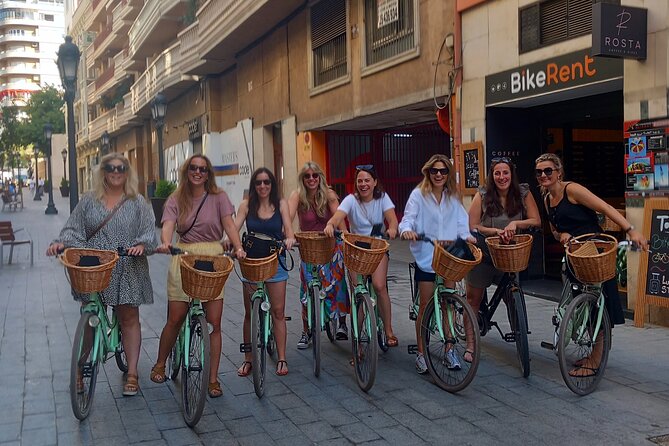
At $42.05 per person for about 2 hours 30 minutes, this tour is priced like a smart add-on—especially because the big stops don’t require paid admission. You get the bike, bottled water, and coffee or tea, so the cost covers the parts that typically add up first: transport and basic drinks.
It runs from 10:30 am and starts at C. Bailen, 14, 03001 Alacant. The tour ends back at the same place, which is handy if you’re trying to stack plans afterward. English is offered, and the group is capped at 10 people, which helps keep the pace friendly.
There’s also a real-world note: this activity needs good weather, so if Alicante is rainy or stormy, you may be offered a different date or a refund. Bring that mindset and treat it like a street-level orientation plus sightseeing.
Finally, there’s no snack included. If you’re the type who gets hungry mid-morning, grab something simple beforehand—then let the tour do what it does best: show you the city’s shape.
You can also read our reviews of more tours and experiences in Alicante.


Where you start matters: Rosta Coffee & Bikes and the ride feel
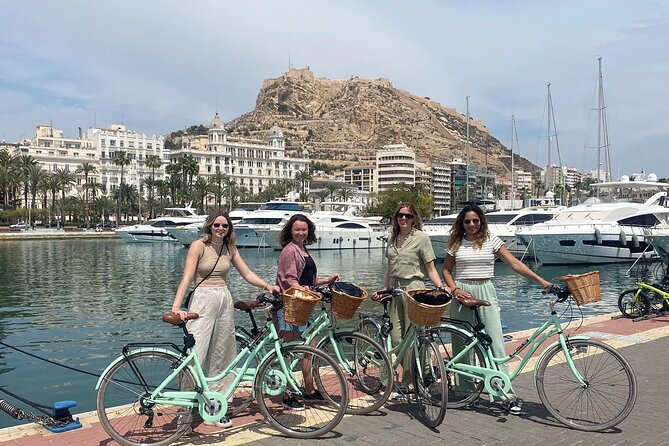
The meeting point is close to public transport, which is good because it makes it easy to arrive without a taxi spiral. Starting at a bike shop also means the pre-tour moment is usually straightforward: pick up the bike, get oriented, and roll out.
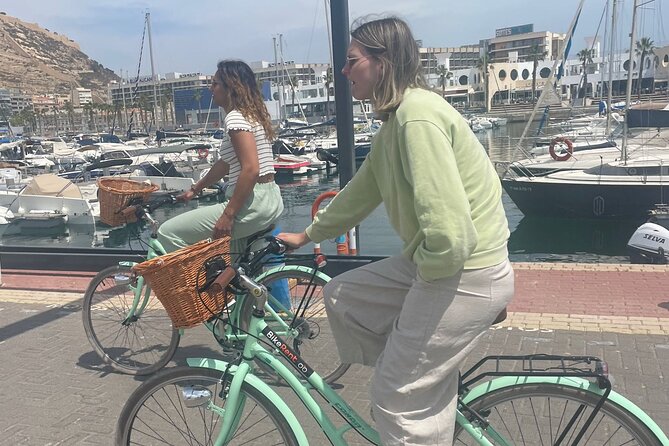
The ride itself is designed to be easy. One review called it an easy, no-hills route with bike lanes, which matches what you’d want for a city highlight tour. You’re not trying to “survive” a workout—you’re trying to cover ground while keeping the streets readable and safe.
Because the group is small, you’ll likely have space to stop when the guide wants to show a detail, then move on quickly. That rhythm matters on a route that touches everything from a modernist market to a sea promenade.
Mercat Central d’Alacant: modernism in the middle of real life
The tour opens with Mercat Central d’Alacant, a central food market that’s still active today. This is one of those places where the architecture does not feel like a museum display. You get to see a working market inside a building with eclectic styling and Valencian modernism details from the early 1900s.
What I like about this stop for your first 10 minutes: it gives you a quick cultural anchor. It’s not just “pretty buildings.” It’s a living local hub, which helps you understand how the city organizes daily life around food and streets nearby.
What to watch for: the ornamental touches and the way the building’s character feels both historical and current. Even if you don’t buy anything, you’ll get a feel for the neighborhood pulse.
Alicante City Hall and Teatro Principal: power and performance
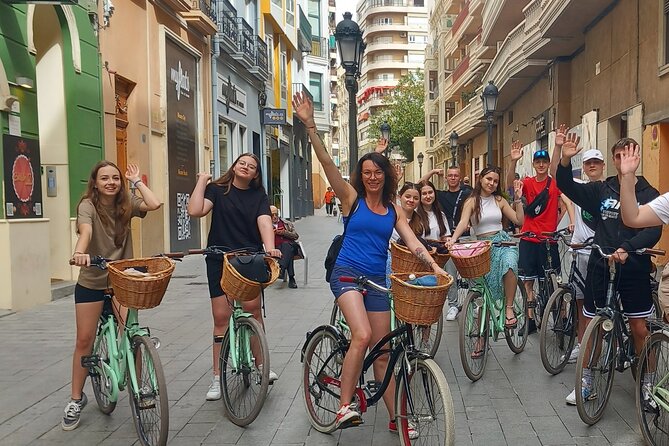
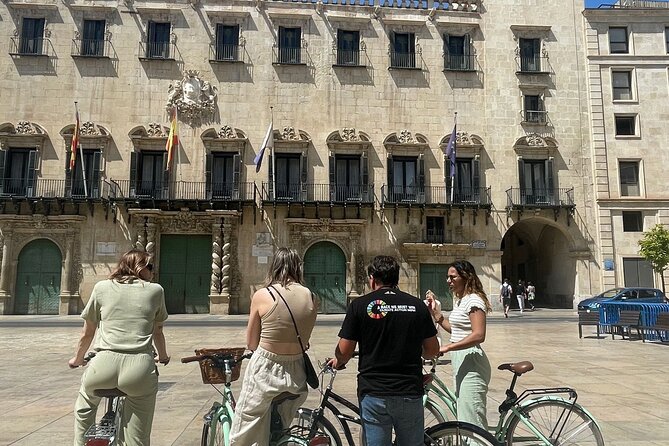
Next comes Alicante City Hall, a municipal baroque-style palace from the 1700s. It’s located between Town Hall and Santísima Faz squares in the Santa Cruz neighborhood. This matters because baroque civic buildings weren’t just built to look impressive—they were meant to project authority in the public center of town.
Then you shift to Teatro Principal de Alicante, the main theater building. It dates to 1846–1847, financed by local business people. That detail is worth noting: it’s one of those reminders that culture often grows when local patrons decide it should.
These two stops work well back-to-back because they show two sides of a city: civic identity and public entertainment. Even with short stop times, you’ll get a quick sense of what kind of community built Alicante’s public spaces.
Port of Alicante history, then the Esplanada’s tile-wave
At the Port of Alicante, you get a strong sense of why the city is here at all. Alicante has been recognized as a public port dating back to 1271. The port’s major engineering—like the stone breakwater projecting into the sea—didn’t start until 1476, which gives you a timeline for how trade shaped the shoreline.
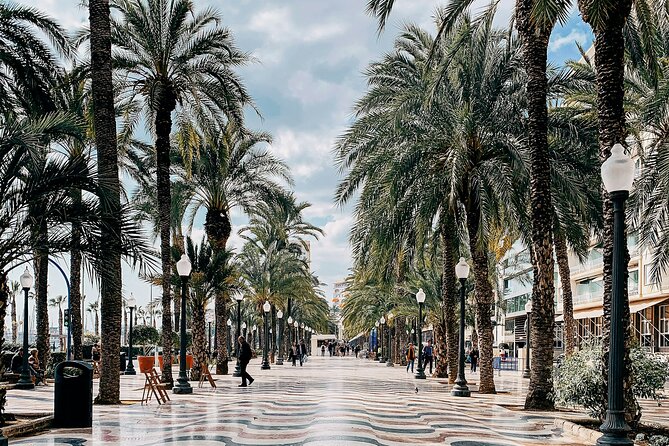
Then comes the star promenade: Passeig Esplanada d’Espanya. This is one of Alicante’s emblems, running parallel to the port docks, lined with palm trees on both sides. The floor is decorated with 6,600,000 tricolor marble tiles, laid out to imitate waves. It’s the kind of detail that makes you slow down, even when your schedule is tight.
Practical tip: wear comfortable shoes for this section. The bike can get you there fast, but the promenade is where your eyes do the work. If you’ve got photos on your list, this is usually where you’ll want them.

Platja del Postiguet: the city’s main beach, right next door
Then you roll toward Platja del Postiguet, Alicante’s main urban beach. It’s a long stretch of sand built for swimming and sunbathing, backed by a bi-level promenade with palm trees and cafes. The “urban beach” part is the key: this isn’t a remote shoreline escape. It’s a place locals use, and that makes it feel real.
Why it’s a good bike-tour stop: it gives you a reset after historic streets and stone buildings. You get sea air, open space, and views that help you mentally map where everything sits relative to the water.
If you’re planning your day around light: mornings often feel calmer. Still, it’s a beach, so expect activity. Don’t treat it like a long lounge session; treat it like a highlight stop that shows you the coastline shape.
Concatedral de San Nicolás de Bari: mosque roots and Gothic cloister
One of the most rewarding moments on the tour is Concatedral de San Nicolás de Bari de Alicante. Built between 1613 and 1662 and designed between 1610 and 1615, it also sits on top of an ancient mosque. That layered footprint is one of those historical facts that instantly makes a building feel deeper than a quick glance.
The church’s older cloister was built in the 15th century in Valencian Gothic style. Even if you only get a short stop, it’s the kind of place where you can spot transitions—different materials, different eras—because the architecture carries the evidence of change.
What to do in your 10-minute window: focus on the big exterior cues and then look for signs of the cloister design. This is also a good stop for quiet attention, since the road rhythm slows a bit here.
Gabriel Miró Square, Canalejas Park, and Rambla de Méndez Núñez
After the big landmarks, the tour turns into city reading—how Alicante connects neighborhoods.
You’ll pass Gabriel Miró Square, also nicknamed Post Office Square. The name reflects the main offices of Spain’s postal and telegraph service that once operated there. This square also has a past connected to boats: it was known as Plaza de las Barcas because boats could reach it.
That detail matters because it links the square directly to the idea of shifting coastlines and changing urban design. Alicante isn’t just a “now” city. It keeps rewriting itself along the water’s edge.
Then you visit Canalejas Park, Alicante’s oldest park, designed in 1886. It runs parallel to Loring Avenue and the marina and sits adjacent to the Esplanada. A park like this is a nice contrast stop: you’re still in city motion, but the greenery gives your legs and eyes a break.
Finally, you ride through the Rambla de Méndez Núñez, a central avenue separating the Center and the Old Town. Until the 19th century, when the city walls were demolished, a 16th-century defensive wall ran along what is now this street. After the walls came down in 1820, the street was built using rubble to fill the ravine. So you’re literally riding on transformed ground—defense to roadway.
If you like understanding how cities grew, this stretch is where you’ll feel the tour working.
Santa Creu Old Town: the streets behind the main sights
The last big area is Barri Vell Santa Creu, often called El Barrio. This hillside Old Town neighborhood is known for its lively nightlife, with cocktail and tapas bars tucked into winding streets.
The landmarks here connect directly back to what you already saw. The area is associated with the blue-domed co-cathedral of St. Nicholas, and the Old Town includes the stately Town Hall flanked by ruined medieval walls. That means the tour isn’t just hopping randomly; it’s building a narrative from buildings you’ve already seen to a neighborhood feel.
Practical way to enjoy this stop: treat it like a photo and orientation moment. You’ll probably want to remember which streets head uphill, where the main squares feel like anchors, and which lanes look easiest for walking later.
If your night plans include tapas, this is exactly where you want your bearings. Even a short time here helps you decide where to wander when you’re off the bike.
Guide quality: friendly check-ins and useful local tips
What makes this tour better than a basic highlight loop is the guiding style. Multiple guides—Alen, Diana, Dajana, Diallo, Juan, and Alant—show up as helpful and easy to work with, with a focus on making sure you’re comfortable on the bike.
One recurring detail: guides often check back to confirm you’re doing well while riding. That sounds small, but it’s huge if you’re not fully confident yet or if you’re navigating unfamiliar street patterns.
Guides also tend to add practical extras. People have been given local eating recommendations, and some guides are happy to snap a few photos during the stops, which is useful if you’re traveling solo or you’re tired of asking strangers.
If you care about getting more than “the official facts,” you’ll appreciate this part. It turns your tour into something you can actually use after your bike is back in place.
What to know before you go: the small trade-offs
This is a “highlights” tour. That’s the deal. With frequent short stops (often around 10 minutes), you’ll see a lot of Alicante, but you won’t linger like you would on a self-guided day.
Also, it’s built for good weather. If you get a gray, windy day, you might feel the time on the beach and open promenade sections a bit more than you’d like.
Finally, snacks are not included. You’ll get bottled water plus coffee or tea, but you’ll still likely want a small bite later, especially if you eat slowly or you’re traveling with kids.
Should you book this Alicante City Bike Tour?
Book it if you want a fast, friendly way to map Alicante: port to promenade, beach to historic streets, then Old Town orientation. It’s also a good value play because the included drinks and bike help offset the price, and many of the major stops you hit have free entry.
Skip it if you crave long museum time or you’re hunting for one huge attraction that you want to spend an hour inside. This tour is designed for movement and highlights, not a slow crawl.
Best fit: first-time visitors, people who like short guided context, and anyone who wants an easy ride with stops that help you understand where everything sits—so your future walks feel effortless.
FAQ
How long is the Alicante City Bike Tour?
The tour runs for about 2 hours 30 minutes.
What time does the tour start, and where is the meeting point?
It starts at 10:30 am. The meeting point is C. Bailen, 14, 03001 Alacant, Alicante, Spain.
Does the tour operate in English?
Yes, the tour is offered in English.
What’s included in the price?
You get bicycle use, bottled water, and coffee and/or tea.
Are admission tickets included for the stops?
The stops listed are marked as free admission tickets.
Are snacks included?
No, snacks are not included.
How big is the group?
The tour has a maximum of 10 travelers.
Is this tour suitable for most people?
Most travelers can participate.
Is good weather required?
Yes. The experience requires good weather, and you’ll be offered a different date or a full refund if it’s canceled due to poor weather.
Can I cancel for a full refund?
Yes. You can cancel up to 24 hours in advance for a full refund. Cancellation less than 24 hours before the start time isn’t refunded.