REVIEW · GLASGOW
Glasgow City and Clyde Bridges Bike Tour
Book on Viator →Operated by Glasgow Bike Tours · Bookable on Viator
Bike tours can feel like a shortcut through a city. This one is different: you get Glasgow’s highlights fast with a guide out front and no map anxiety.
I especially like the bike and helmet rental included, which makes it easy to show up and start pedaling. Second big win: the pace is built for sightseeing, not sprinting, so you can actually look up and take photos between the stops. My only watch-out is that if your comfort level with hills and city traffic isn’t great, you’ll want to ask your guide what the road feels like on your date and ride accordingly.
In This Review
- Quick reasons this bike-and-bridges route works
- From Drygate to the first pedals: what the start is really like
- Peoples Palace and Winter Gardens: Glasgow’s dramatic opening
- SEC Armadillo and the University area: fast facts with a cold joke
- Kelvingrove Art Gallery, Glasgow Cathedral, and the Glenlee ship in one sweep
- Whisky stop at Clydeside Distillery, then the Necropolis at scale
- Riverside Museum and Kelvin Park: when the ride turns scenic
- Squinty Bridge, Speirs Wharf, and the Clyde River: Glasgow’s water story
- Bikes, hills, and traffic safety: the stuff that affects your day
- Value and what $81.87 buys you in real terms
- Should you book this Glasgow City and Clyde Bridges bike tour?
- FAQ
- How long is the Glasgow City and Clyde Bridges Bike Tour?
- What’s the group size limit?
- Where does the tour start and end?
- Do I need to book an e-bike in advance?
- Are attraction entry fees included?
- What kind of cycling ability do I need?
Quick reasons this bike-and-bridges route works
- Small groups (max 10) mean more room to ask questions and get re-oriented if traffic or weather shifts.
- Guide-led navigation keeps you focused on sights instead of route-planning.
- Postal-style bikes make the ride feel like local history, and most people find them manageable for a 3-hour loop.
- Free entry tickets at many stops lower the cost of doing major attractions back-to-back.
- River and university area time gives you a Glasgow rhythm that walking can’t match.
From Drygate to the first pedals: what the start is really like
Your tour begins at Drygate Bar, Kitchen and Brewing Co., an easy-to-find spot in Glasgow’s south. This matters because a bike tour lives or dies on how smoothly the first 15 minutes go. You’ll get geared up with your bike and helmet (helmet is optional, but I’d strongly consider it), plus time to adjust before you join the route.
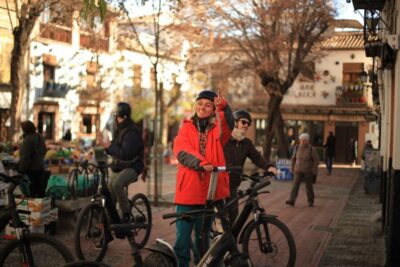
One practical note: the bikes are described as older, postal-style models. That’s part of the charm, but one review also mentioned the bikes being fairly basic (like having only 3 gears). Translation for you: if you know you need more gearing, don’t just assume you can muscle through. Ask early, and choose your effort level on the first climbs.
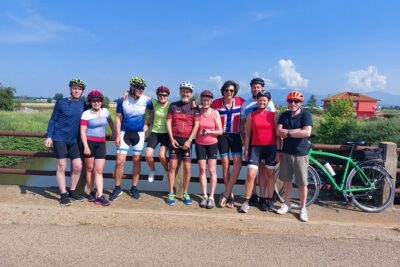
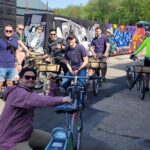
Also, you’re in a small group (10 max). That usually means the guide can keep everyone together without the constant stop-and-wait feeling you get on larger tours. You’ll still want to ride with intention. If you drift, stop for extra photos for too long, or go at a slower pace than the group, you can get separated from the flow.
A fun detail from the guide experience: names like Keith, Mike, Dillon, Alastair, Johann, Owen, Ali, and Owen show up in feedback, and the theme is consistent—friendly guidance, traffic-smart routing, and humor that makes architecture and history easier to follow. Even on days where the group is smaller (one departure reportedly turned private when there was only a single party), the goal stays the same: safety first, then good stories.
You can also read our reviews of more tours and experiences in Glasgow.
Peoples Palace and Winter Gardens: Glasgow’s dramatic opening
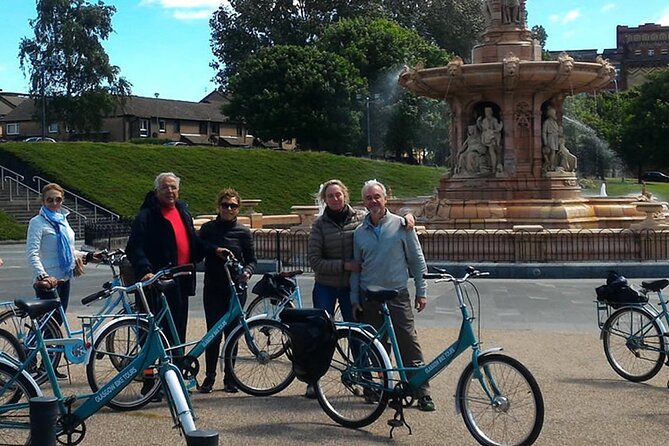
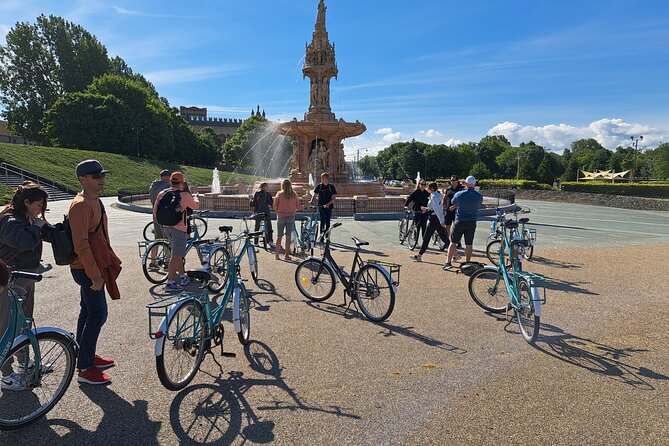
The first stop is People’s Palace and Winter Gardens. This isn’t just a pretty facade stop. You’ll get a quick hit of the Glasgow mindset: big civic buildings built with big belief in the future. It’s the kind of place that makes you understand why the city’s identity is equal parts grit and imagination.
The best part here is the momentum. You start with a building that feels like a statement, and you’ll be on a bike for the rest of the day. That means you’re not spending your whole trip stuck inside. You’re learning the vibe while you’re still fresh enough to enjoy the ride.
Time at the stop is about 15 minutes, and admission is free (ticket free). This is the right length for photos and a basic orientation without feeling like you’ve booked a museum marathon.
SEC Armadillo and the University area: fast facts with a cold joke
From there you head toward the SEC Armadillo, a modern Glasgow landmark with a design that’s easy to spot and even easier to learn about. The tour explanation focuses on what inspired the look of the building. If you like architecture details, this is one of those quick stops where you’ll leave with a clearer mental picture instead of just knowing a name.
Next comes the University of Glasgow, with a fun theme: you’ll hear a connection tied to -273°C and the Gilmorehill campus. It’s wordplay, but it also works as a memory anchor. You remember the temperature because the guide ties it to the place.
Why these stops together work: they map Glasgow’s shift from civic ambition to modern institutions. On foot, you can technically walk between them, but biking compresses the time so you don’t lose the day to transit and street crossings.
Both are short stops (about 15 minutes each), and admission is marked as ticket free for the tour. That matters in a city where paying for multiple attractions can add up fast.
Kelvingrove Art Gallery, Glasgow Cathedral, and the Glenlee ship in one sweep
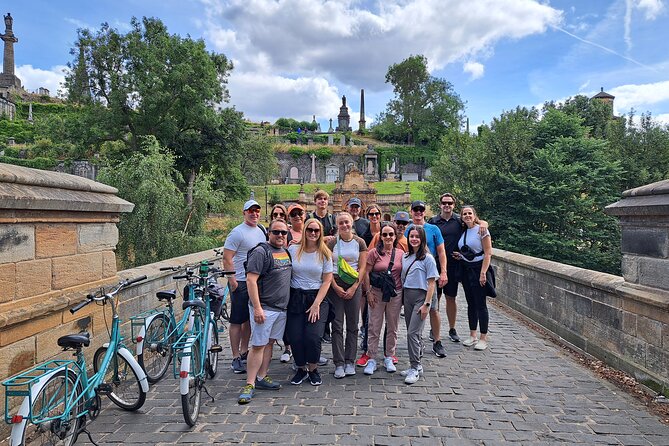
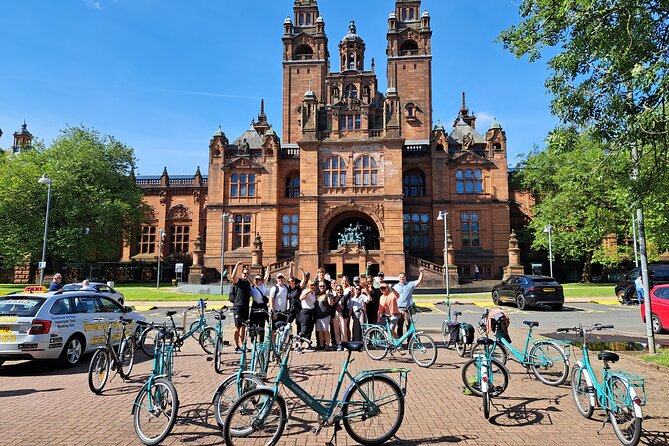
You’ll then reach Kelvingrove Art Gallery and Museum, another major Glasgow stop with free-to-enter access. The tour frames it as a place worth your time even if you’re trying to keep the budget tight. This is one of the easiest “yes” stops on the route because it’s the kind of attraction that’s hard to appreciate fully if you’re only there for an hour, yet it’s still satisfying in short form when you’re on a schedule.
Kelvingrove is about 15 minutes on the tour, so you won’t be trying to see everything. Instead, you’ll skim the highlights and walk away understanding why locals keep pointing visitors here.
After that, you’ll move on to Glasgow Cathedral for a quick history fix. The stop leans on an old anchor date—1189—to get you thinking about how long the city has been building, remaking, and surviving.
Then comes a maritime pause at the Tall Ship Glenlee. It’s a quick 10 minutes, and admission is not included. Here’s how to plan your decision: if you want to step aboard and poke around, budget for that extra entry. If you mainly want the sight of the three-masted ship, you can still enjoy the stop without feeling like you missed the whole point.
All three of these are short stops by design. That’s what makes the tour feel like a sampler of Glasgow rather than a single-venue day.
Whisky stop at Clydeside Distillery, then the Necropolis at scale
After the cathedral-and-ship cluster, you’ll get a different kind of Glasgow: Clydeside Distillery. The tour spot is timed around 10 minutes, and the admission is listed as free for this stop. The framing is simple: whisky is part of the story of Glasgow, and the guide turns that into a fast, memorable stop.
This is also one of the moments where the bike tour format shines. On foot, whisky tastings often hijack a day. Here, it stays as a brief cultural stop, so you stay in control of your energy.
From there, you’ll hit the Necropolis, which is not subtle. This is where the tour leans into scale—50,000 people connected to the place. It’s a cemetery, yes, but it’s also an outdoor architecture and history experience. And the guide’s jokes are part of it: you’ll get a sense that the city treats this location as something you should notice, not something to avoid.
Time is about 15 minutes and admission is ticket free. If you like places that feel a little eerie in a good way, this is one of the more memorable stops.
Riverside Museum and Kelvin Park: when the ride turns scenic
Next you’ll reach Riverside Museum for about 10 minutes. The tour description calls out the range of what’s inside, from skateboards to aircraft. That’s the kind of contrast that makes the museum feel less like a stuffy lecture and more like a museum built for real people’s interests.
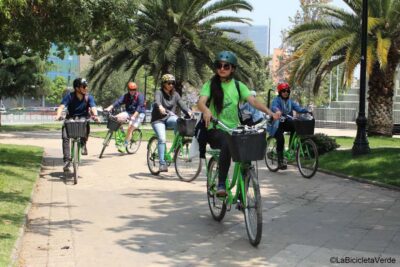
Then you get Kelvingrove Park time. The best part isn’t just the greenery. It’s the cycle path along the Kelvin river, which turns the ride into something closer to a countryside path than an urban scramble. One review also mentions the contrast of nature and real Glaswegian life right on the route (including people enjoying buckfast tonic wine). That’s not the tour’s theme, but it’s exactly the sort of street-level texture a bike tour can catch.
These stops also help you reset between heavier sightseeing. The route spends enough time in the city streets to connect the dots, then gives you this calmer ribbon of riding to breathe.
Squinty Bridge, Speirs Wharf, and the Clyde River: Glasgow’s water story
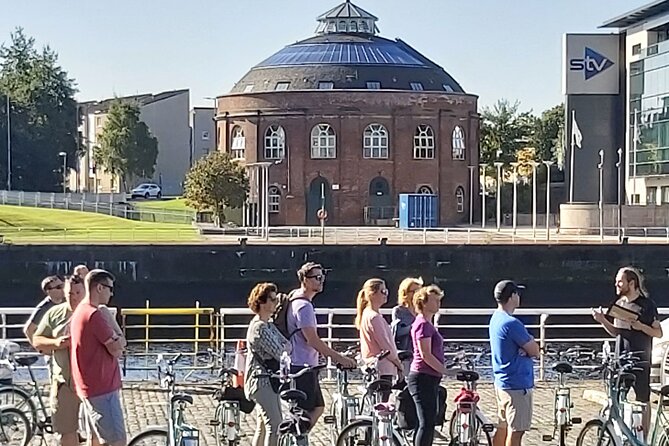
The next set of sights leans heavily into the city’s bridges and waterfront character. First up is the Clyde Arc Bridge, famously nicknamed the Squinty Bridge. It takes only about 5 minutes on the schedule, but it’s a very high-impact moment because you’re likely to catch it from a moving perspective. Seeing a bridge while riding hits differently than seeing it from a stationary viewpoint.
Then you’ll pass Speirs Wharf. This is where you get a history nugget: it’s described as completed in 1790 and tied to connecting routes across the east and west coast. The quick timing (about 10 minutes) is intentional: this is a snapshot that gives context for why the riverfront looks the way it does today.
After Speirs Wharf comes the River Clyde stretch. Plan for about 20 minutes here, with time focused on learning the bridge nicknames and getting a river view. There’s also a line about stopping for a quick dip, but don’t count on that part unless your guide confirms it for your day. In real life, it depends on conditions and group comfort.
The finale is your ride back toward Drygate, ending where you started. The loop format matters. You end with your legs tired in a good way and your head full of Glasgow images, not with a random drop-off that leaves you needing a transportation plan.
Bikes, hills, and traffic safety: the stuff that affects your day
This tour is listed for people who are fit enough to ride a bicycle, and that’s fair. The route includes a mix of flatter sections and some hills. One review explicitly warned about a handful of hills that can get your heart racing, while still saying that someone in generally good health should be able to do it.
So here’s how you decide if this fits you:
- If you can comfortably ride for 2 to 3 hours and you’re used to city cycling, you’ll likely feel fine.
- If you rarely ride, this can still work, but you’ll want to move slower, start strong on your gearing, and don’t feel embarrassed to request a steadier pace.
- If you’re worried about hills, there’s an e-bike option for an extra £20 supplement (you must book it direct). That’s worth considering because it keeps the sightseeing pace from turning into a leg workout.
Traffic is another key point. Multiple reviews praised guides for navigating roads safely and keeping the route manageable. Still, you should treat the tour as guided city cycling, not a leisurely lane cruise. Your guide is leading, but you still need awareness and smooth pedaling.
On pace: one review mentioned the guide leading a bit too fast and bikes being left behind when photo stops took longer. That’s a useful heads-up for you. If photography is important, build quick photo moments in your head, not long detours.
Value and what $81.87 buys you in real terms
The price is listed at $81.87 per person for about 3 hours. That can sound like a lot until you translate it into how bike tours actually cost you.
Here’s what you’re getting that reduces hidden expenses:
- Standard bicycle use is included.
- Helmet is provided if you want it.
- A guide in English stays with the group.
- Free admission tickets are included for many stops, including big-name places like Kelvingrove Art Gallery and Museum (and multiple other landmarks are marked free).
- Secure parking is offered for direct bookings, which is rare and can matter if you’re arriving by car.
When you add it up, the tour is basically bundling transportation + guiding + a chunk of entry fees into one payment. For a short, intense highlights day, that can be a strong value.
Also, the tour has a booking pattern of being made far enough ahead on average (about 49 days). That’s a sign it’s popular, so if your dates are firm, don’t wait too long.
Should you book this Glasgow City and Clyde Bridges bike tour?
Book it if you want an efficient Glasgow overview where you can see major landmarks and still spend time on scenic river routes. This is especially good for first-time visitors who find walking too slow and who prefer a guide to handle navigation and traffic choices.
Skip it or consider an e-bike if you don’t feel steady on hills, or if you need long photo pauses and lots of stopping. Also, if you love museums in-depth, this route is a sampler. You’ll get the highlights, not the full deep dives.
If you’re the kind of traveler who likes architecture, bridges, and city atmosphere in one morning or afternoon, this tour is a smart way to spend it. And with a small group capped at 10, you’re more likely to get real answers to your questions instead of being rushed past everything.
FAQ
How long is the Glasgow City and Clyde Bridges Bike Tour?
It runs for about 3 hours.
What’s the group size limit?
The tour is limited to a maximum of 10 travelers.
Where does the tour start and end?
It starts at Drygate Bar, Kitchen and Brewing Co., 85 Drygate, Glasgow G4 0UT, UK and ends back at the meeting point.
Do I need to book an e-bike in advance?
An e-bike is available for a £20 supplement, but it must be booked direct.
Are attraction entry fees included?
Admission is listed as free for most stops. Tall Ship Glenlee is the one noted as not included.
What kind of cycling ability do I need?
You should be fit enough to ride a bicycle, and there are some hills on the route. The tour operates in good weather.