Lisbon’s hills are no joke. This guided e-bike tour turns them into a photo-friendly ride through the city’s best viewpoints and old neighborhoods. You get a smart mix of “look from above” moments and “see it up close” streets, without spending your whole day climbing stairs.
Two things I love: the tour keeps groups to just 7 people, so your guide can actually manage crossings and help you stay together, and it hits the viewpoints you usually end up hunting for on your own. A possible drawback: you’ll roll over cobblestones and share narrow lanes with pedestrians and cars, so a calm head and basic bike confidence matter.
I also like how the tour balances big-scenery stops (the miradouros) with cultural stops that feel specific, like the azulejo-tile heritage in Graça and the tile-and-people details inside Alfama and Mouraria. For me, that’s what makes the ride more than a scenic loop: you leave with context, not just pictures.
In This Review
- Key highlights you’ll actually feel on the ride
- E-bikes that make Lisbon’s hills doable without killing the fun
- Starting point on Rua dos Caminhos de Ferro and what that means for your timing
- Miradouro São Pedro de Alcântara: the famous center-and-east-city panorama
- Largo do Carmo: convent ruins and the Santa Justa elevator connection
- Viúva Lamego tile artistry: why azulejos matter to Lisbon
- Senhora do Monte and the Graça side: two big miradouros from high above
- Mercado de Santa Clara: markets, monasteries, and the Flea Market timing
- Alfama by e-bike: narrow lanes, multiple viewpoints, and street-level Lisbon
- Castle neighborhood: oldest houses and the gate-to-view shift
- Mouraria’s street portraits: the funny detail that sticks with you
- City center finish: Rossio, Rua Augusta Arch, and Comércio Square by the Tagus
- What you’re really paying for: value of a $54.42 e-bike overview
- Safety on cobblestones and through crowds: how to avoid the common headaches
- How fit do you need to be, really?
- Who this tour suits best (and who may want a different style)
- Should you book this Lisbon e-bike tour?
- FAQ
- How long is the 7 Hills and 14 Viewpoints Lisbon e-bike tour?
- What’s the group size limit?
- Is the tour offered in English?
- Where does the tour start?
- Are helmets and bicycle use included?
- Are monument tickets included?
- What kind of fitness level do I need?
- Is food included?
- What’s the cancellation rule if I need to change plans?
Key highlights you’ll actually feel on the ride
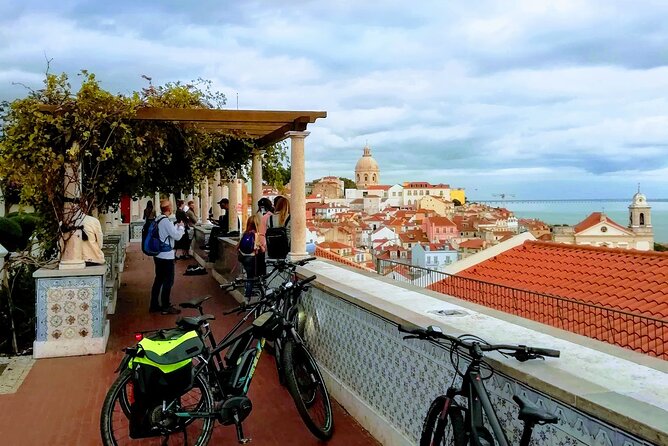
- 7 riders max means less waiting and more guide attention at tricky street moments
- Four hours, lots of viewpoints: miradouros up high plus multiple photo chances down in the streets
- Story-first guiding led by local-born energy, with history tied to what you see on the street
- Azulejo tile stop at Viúva Lamego gives you a concrete Lisbon detail beyond postcards
- Alfama + Mouraria connections: cathedrals, churches, and even street portraits on house walls
E-bikes that make Lisbon’s hills doable without killing the fun
Lisbon is famous for steep grades, and that can turn a “see the city” day into a leg workout. That’s why an e-bike matters here: you still pedal, but the assist helps you glide up the tough bits so you can enjoy the ride and keep your energy for stops.
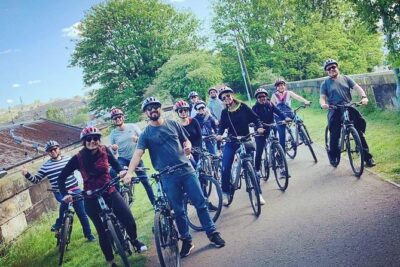
The group size is the other half of why this tour works. With a maximum of 7 travelers, you don’t feel like you’re trapped behind a long line of bikes, and the guide can slow down when the route gets crowded. In a city where sidewalks and streets can get packed, that makes a real difference.
One more thing I appreciated: you get helmets, and the bikes are described as well-maintained in multiple experiences. Still, Lisbon doesn’t stop for machines. Expect bumps, slow moments, and occasional detours around crowds.
You can also read our reviews of more tours and experiences in Lisbon.


Starting point on Rua dos Caminhos de Ferro and what that means for your timing
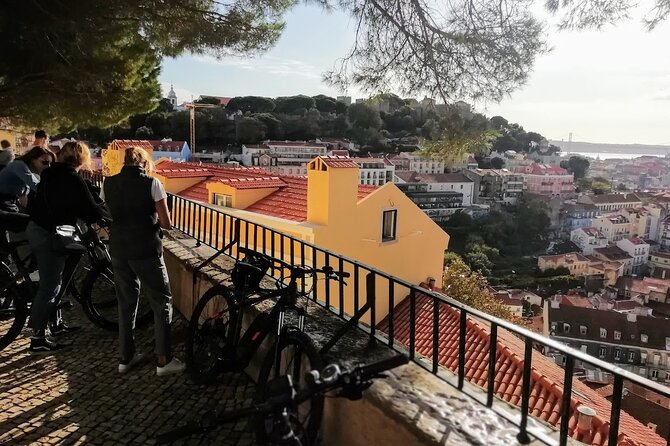
The tour starts at Rua dos Caminhos de Ferro 62 (1100-108 Lisboa) at 10:00 am and loops back to the same meeting point. This is a practical schedule for getting big viewpoint hits early, then having the rest of your day free to wander.
You’ll have a mobile ticket, and the route is close to public transport. That matters because you don’t want your sightseeing day to hinge on a complicated logistics puzzle. Easy start, easy finish.
Plan for about 4 hours on the clock. Within that time you’ll mix uphill viewpoint stops, guided history breaks, and short ride segments through dense neighborhoods. If you want a “one-day overview” that doesn’t swallow your entire day, this hits a good time window.
Miradouro São Pedro de Alcântara: the famous center-and-east-city panorama
Your ride kicks off at Miradouro São Pedro de Alcântara, one of Lisbon’s best-known viewpoints. From here, you can look across the historic center and out toward the eastern part of the city, which is exactly the kind of wide angle that makes you instantly understand Lisbon’s shape.
Why it’s a smart first stop: it gives you bearings. After this, the rest of the tour feels like you’re moving through a real map, not just hopping between random photo spots.
It’s a quick photo pause—about 5 minutes—and it’s free to visit. The short timing is good for keeping the group moving and for avoiding “stand around and lose the moment” fatigue.
Largo do Carmo: convent ruins and the Santa Justa elevator connection

Next comes Largo do Carmo, a small square with serious Lisbon story weight. This is where you can see the Carmo Convent ruins and also consider going up the top of the Santa Justa elevator (both are mentioned as possibilities at the stop).
There’s a practical angle here too: elevators and ruins can eat time if you try to plan them yourself. Having the option built into the tour means you can choose what fits your interest without building a separate itinerary.
The stop is around 5 minutes, so don’t expect a long sit-down moment. Use it as a “capture and orient” stop, then get back on the bike for the next viewpoint rhythm.
Viúva Lamego tile artistry: why azulejos matter to Lisbon
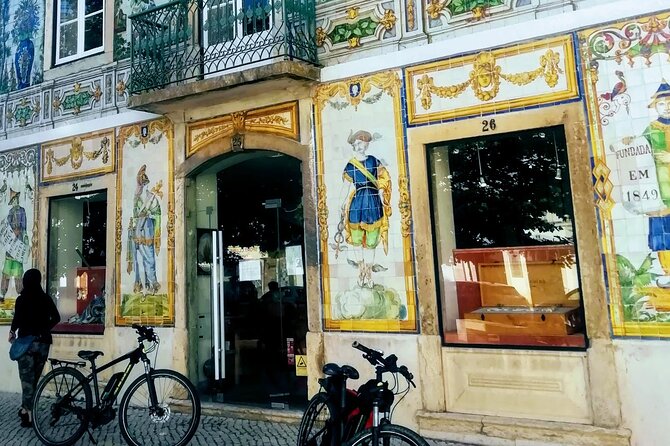
At Viuva Lamego, you’re in the world of azulejos—Lisbon’s iconic painted tiles. The tour gives you a reason those tiles are everywhere: this building connects to the works and installation of tiles made for decorating many buildings.
This stop is about more than pretty surfaces. When you learn how the tile craft shaped Lisbon’s look, you start noticing details on facades you would otherwise ignore. You also get a stronger sense of how local industry and style created the city’s visual identity.
It’s another quick 5-minute stop with free entry noted. Even if you’re not a tile-spotter, it’s a useful mid-tour reset that turns “I’ve seen buildings” into “I know why these buildings look like this.”






Senhora do Monte and the Graça side: two big miradouros from high above
Your route climbs to Miradouro da Senhora do Monte, described as the most beautiful viewpoint in the city. The payoff is the “almost whole city” perspective—like being up in the air—so you can see how neighborhoods stack across the hills.
This stop is also tied to long importance for the city about 900 years ago, with a story shared when you arrive. That blend of view plus context is what keeps these miradouros from feeling like stand-alone postcards.
From there you head into Graça, including Miradouro da Graça (Sophia de Mello Breyner Andresen). Here, you get another viewpoint angle and you’re close enough to see São Jorge Castle from nearer in the frame. The tour also mentions free access options for the church and part of the Graça convent.
The Graça area is especially good if you want that “two perspectives in one zone” feeling: wide view from above, then a more local-feeling neighborhood vibe.
Mercado de Santa Clara: markets, monasteries, and the Flea Market timing
Next is Mercado de Santa Clara, which puts you in the center of an important area of Lisbon. The big practical detail here is the market timing: on Tuesday and Saturday, it hosts the oldest street market in Lisbon—the Flea Market.
Even if your day isn’t a market day, this stop helps you see Lisbon as a lived-in city, not only a sightseeing list. Nearby monuments are also part of the moment: you’ll observe the São Vicente de Fora Monastery and the National Pantheon from the outside.
It’s about 10 minutes, so keep your expectations tight. Use it to grab a quick feel for the neighborhood and to switch gears from hillside viewpoints to city life.
Alfama by e-bike: narrow lanes, multiple viewpoints, and street-level Lisbon
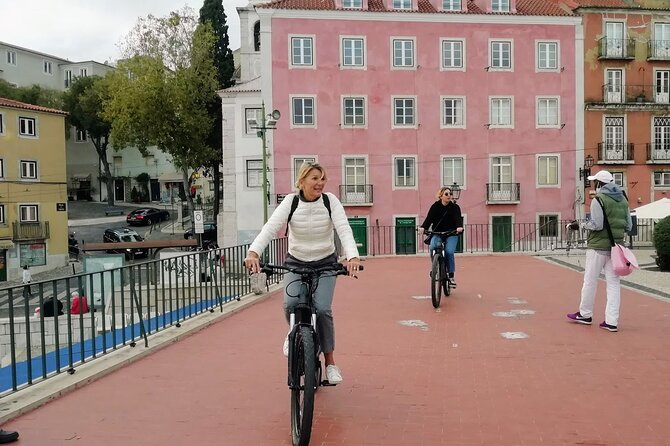
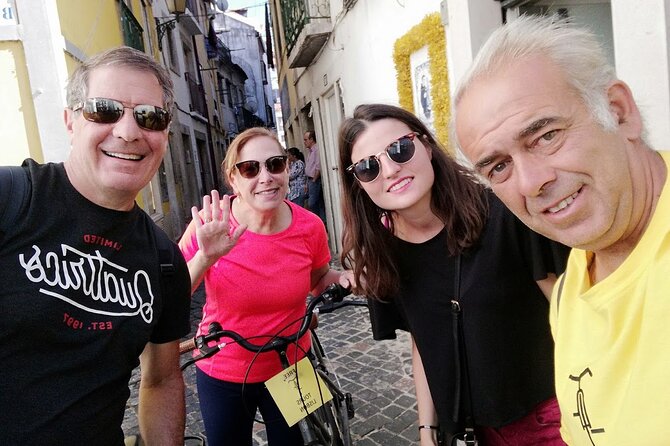
Now the tour gets really fun in the way that matters. You move into Alfama, Lisbon’s oldest traditional neighborhood, and you’ll cycle through very narrow and small streets that can feel like a maze. That’s the point: Alfama is where Lisbon stops being a concept and becomes an experience.
This is also where the tour adds personality. The plan includes short stops to learn local history, talk with local people, and toast with a small cup of ginjinha. For me, that’s the line between a sightseeing tour and something that feels Lisbon-like.
You also hit multiple viewpoint stops clustered within the Alfama area: Santo Estevão, Santa Luzia, Cerca Moura, and Portas do Sol. That’s a big deal because it means the “four hours” doesn’t only contain one or two view moments. You keep collecting perspective as you go.
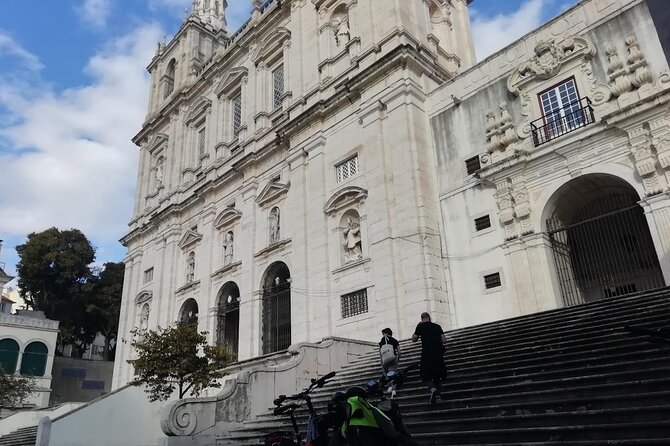
The tour also cycles through major religious landmarks in the area, including Lisbon Cathedral and Santo António Church. Expect that your guide will connect what you see—church steps, facades, street layouts—to the neighborhood’s past.
This part runs the longest in the itinerary segment, about 30 minutes. It’s the heart of the route, and the segment where you’ll feel the most “Lisbon, up close” energy.
Castle neighborhood: oldest houses and the gate-to-view shift
After Alfama, you head into the São Jorge Castle area. This section is described as a network of narrow streets again, but with the added sense of stepping closer to the city’s historic power center.
You’ll see some of Lisbon’s oldest houses and move toward the castle gate. The vibe shift is what you’re looking for: from street-level neighborhoods and churches to a more fortified feel where the city’s story becomes literal stone and walls.
It’s a shorter stop—about 10 minutes—but that’s smart here. You’ll get the view connection and the old-town feel, then you keep rolling so the tour doesn’t turn into a waiting game.
Mouraria’s street portraits: the funny detail that sticks with you
Bordering the castle and Alfama is Mouraria, another of Lisbon’s oldest areas. The streets are also narrow, and the tour includes curious surprises—one of the fun ones are the hundreds of pictures hanging on the streets showing the people who live there.
That’s not just decoration. It gives you a sense that neighborhoods aren’t museum pieces. The walls show identity, and the city feels like it’s still being written by residents, not only by history guides.
You’ll spend about 10 minutes in this segment. It’s short, but it’s the kind of detail that makes your photos feel different from the standard miradouro snapshots.
City center finish: Rossio, Rua Augusta Arch, and Comércio Square by the Tagus
The tour then loops back toward the city center, where you’ll pass by large squares and major landmarks. You’ll visit São Domingos Church, and the route takes you through Praça do Rossio at the base of the Santa Justa elevator.
You’ll also go under the Rua Augusta Arch, and then enjoy Comércio Square, right by the Tagus River. This is a great ending pattern: you start with wide city views, ride through intimate neighborhoods, and finish with the center’s bigger architectural drama.
If you want a clean mental map, this is where it clicks. You see both the “up and down” and the “center in full view” side of Lisbon in one guided session.
What you’re really paying for: value of a $54.42 e-bike overview
At $54.42 per person for about 4 hours, the value isn’t just the bike rental. It’s the structure: you get a guided route that hits multiple viewpoints, multiple neighborhoods, and several cultural checkpoints without you needing to plan a route between steep hills.
You also get helmets, a guide, use of the bicycle, and free monument tickets tied to stops. That means you’re not constantly checking whether an entrance fee will pop up at your next photo stop.
In real terms, this is the kind of tour that makes sense if you want to cover ground quickly while still feeling like you’re getting Lisbon—not only cycling, and not only walking. It’s also a smart “first days in Lisbon” choice, since it gives you reference points for the neighborhoods you’ll want to return to on foot later.
Safety on cobblestones and through crowds: how to avoid the common headaches
Here’s the honest part. Lisbon streets can be crowded, and you’ll be biking on cobblestones through areas with people and cars. Multiple experiences mention the need to navigate carefully—especially around traffic and busy crossings.
A “word of warning” that matters: if you’re nervous around cars, bike tours anywhere in a historic center can feel stressful. This tour can still be safe, but you have to be willing to ride calmly and follow the guide’s lead at every crossing.
Also pay attention to route details like tram or trolley tracks if they’re in your path. One nervous rider may have an easier time with slower pacing, and the guide may keep the group together rather than forcing fast movement.
Weather changes the difficulty too. Cobblestones can get slippery in the rain, and one experience described a rainy day as more challenging because of slick surfaces and heavy traffic. If you’re booking a day with questionable weather, go in with that realism.
How fit do you need to be, really?
The tour calls for moderate physical fitness, and that matches what e-bikes do well. You don’t need to be a hardcore cyclist. The hills are the challenge, but the assist helps a lot.
Still, fit isn’t the only issue. Bike handling confidence is a key factor because you’re riding in real streets with pedestrians and traffic. One account specifically pointed out that even if the e-bike makes hills easy, you still need comfort managing your bike around others.
So I’d think of it like this: if you can ride a bicycle at a relaxed pace and you’re comfortable stopping and starting, you’re probably fine. If the idea of traffic makes you tense, you might want to reconsider or ask what the guide’s pace looks like before you commit.
Who this tour suits best (and who may want a different style)
This works very well for people who want:
- A quick overview with real viewpoint payoff
- A guided route that reduces decision fatigue in Alfama and the castle area
- A mix of photo stops plus neighborhood stories
It’s also a solid option for families with teenagers, since one experience rated it positively for that age group. If your teens can handle bike riding, they’ll likely enjoy the variety: viewpoints, tiles, markets, and street portraits.
It may be less ideal if:
- You’re strongly uncomfortable biking near vehicles
- You get rattled by cobblestones and crowds
- You’re not confident staying with a small group in tight streets
Should you book this Lisbon e-bike tour?
If you want a high-value, time-efficient way to see Lisbon’s viewpoints and old neighborhoods in one guided day, I think this is a strong choice. The 7-person cap, the multiple miradouros, and the way the tour connects city views to specific neighborhood details make it feel worth the money.
Book it if you’re excited by the idea of collecting perspectives from above and then snapping photos as you roll through Alfama and Mouraria. Skip it if you’re likely to freeze at road crossings or if cobblestones and crowding will stress you out more than you’ll enjoy the scenery.
Either way, do yourself a favor: show up ready to ride carefully, and treat the guide’s instructions like the steering wheel. Lisbon is gorgeous—but it’s still a real city.
FAQ
How long is the 7 Hills and 14 Viewpoints Lisbon e-bike tour?
It runs for about 4 hours.
What’s the group size limit?
The tour caps at a maximum of 7 travelers.
Is the tour offered in English?
Yes, it is offered in English.
Where does the tour start?
It starts at Rua dos Caminhos de Ferro 62, 1100-108 Lisboa, Portugal.
Are helmets and bicycle use included?
Yes. Helmets and use of the bicycle are included.
Are monument tickets included?
Yes. Free monument tickets are included as part of the tour.
What kind of fitness level do I need?
The tour asks for a moderate physical fitness level.
Is food included?
No. Food and drinks are not included.
What’s the cancellation rule if I need to change plans?
You can cancel for a full refund up to 24 hours before the experience starts, and it may be canceled due to poor weather with options to pick another date or get a refund.