REVIEW · LISBON
Lisbon E-Bike Tour Commerce Square, Mouraria and Alfama
Book on Viator →Operated by Boost Portugal · Bookable on Viator
Lisbon’s hills turn into a feature, not a fight. This 3-hour e-bike ride lets you cover seven-hill neighborhoods with electric help while your guide points out Lisbon’s turning points, from Comércio Square to Alfama.
I especially like the way the route mixes classic landmarks with the street-level feel of old Lisbon, and the focus on viewpoints like Graça and Senhora do Monte for Tagus River views. The ride also benefits from small-group attention, which matters on narrow cobblestones and tight corners. A possible drawback: you still need to be comfortable biking on uneven, bumpy stone streets, since the assist helps but it doesn’t make Lisbon’s old streets smooth.
In This Review
- Key highlights worth showing up for
- Why an e-bike makes Lisbon feel doable
- Getting bike-ready at Boost Portugal
- Stop 1: Praca do Comercio and Lisbon’s 1755 reset
- Museu do Fado: how music connects to neighborhood life
- National Pantheon (St. Engratia): a long build with big presence
- Sao Vicente de Fora: monarchy stories inside a monastery
- Graça viewpoints and the Tagus River drama
- Alfama: medieval lanes, fado houses, and St. Anthony energy
- Lisbon Cathedral (Sé de Lisboa): oldest worship, thick walls, old power
- Martim Moniz and the hill-crossing story
- Senhora do Monte: one of the highest views for city and river
- How the guide keeps the group safe on tight cobblestones
- Price and value: what $30.23 covers (and what it doesn’t)
- Who should book this e-bike tour
- Rain, timing, and what to pack
- Should you book it?
- FAQ
- Do I need prior experience riding an e-bike?
- What physical condition do I need?
- What’s included in the tour price?
- Are entrance fees to sights included?
- Will the tour run if it rains?
- How big is the group?
- Can I cancel and get a refund?
Key highlights worth showing up for
- Electric assist on seven hills so you spend energy on sights, not exhaustion
- Tagus River viewpoints from Graça areas and Senhora do Monte
- Fado and Alfama connections woven into the ride through the oldest neighborhood
- Major old-Lisbon stops including National Pantheon (St. Engratia) and Lisbon Cathedral
- Small-group feel (max 24) with safety guidance that keeps everyone together
- Rain-ready setup, including ponchos when weather turns
Why an e-bike makes Lisbon feel doable
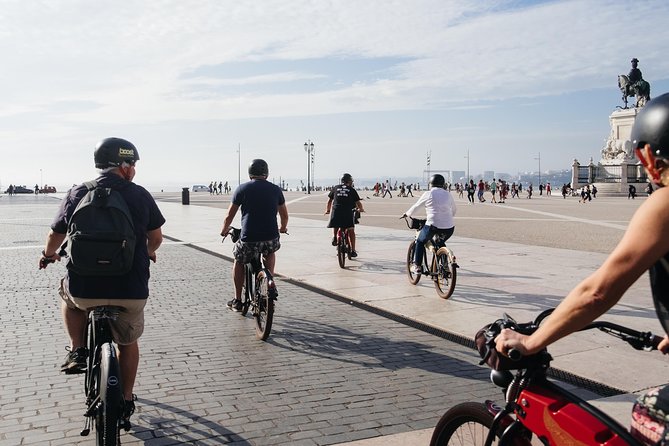
Lisbon is famous for hills, but on a normal bike, those hills can eat your whole day. Here, the electric assist means you can keep moving uphill without getting completely cooked. You’ll still work a bit, but the bike does the heavy lifting when the route starts climbing toward viewpoints.
The payoff is that you get more of the “real Lisbon” in less time. Instead of choosing between walking a steep stretch or skipping it, you can ride through it, then stop to look around properly—especially when the guide pulls the group into view corridors where you can actually see the city center and the river.
That’s also why this tour works as a first or mid-trip orientation. It’s not just sightseeing. It’s a fast way to understand how Lisbon is laid out: riverfront, hill districts, and those viewpoint moments that change how the city feels.
You can also read our reviews of more tours and experiences in Lisbon.

Getting bike-ready at Boost Portugal
You start at Boost Portugal – Urban Thrills in central Lisbon (R. dos Douradores 16). The big advantage of meeting at a shop-based hub is that you get an equipment adaptation lesson before you roll out. No one is tossing you into traffic after a five-second tutorial.
You’ll also get a safety and operations briefing, plus a helmet and insurance coverage included with the tour. That matters on this route because you’re not just pedaling straight lines. You’re riding cobblestones, navigating tight old-town lanes, and stopping frequently for photos and stories.
If you’re a confident bike rider, you’ll feel in control right away. If you’re nervous around close spacing or bumpy surfaces, be honest with yourself here—this is still an active street ride, not a gentle promenade.
Stop 1: Praca do Comercio and Lisbon’s 1755 reset
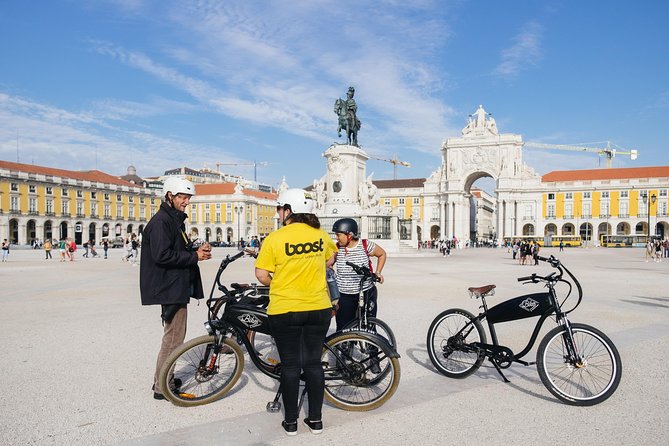
You begin at Praca do Comercio, Lisbon’s large river-facing square. It’s also tied to the aftermath of the 1755 earthquake and the rebuilding that shaped the city’s modern center. Facing the water, the square reads like a “front door” to Lisbon, with the river and open space doing a lot of work for your orientation.
What I like about starting here is the contrast. From wide-open riverfront space, the ride quickly turns into narrow streets and climbs. That makes the later districts—especially Alfama—feel more meaningful once you’ve seen how Lisbon opens up toward the Tagus.
Time-wise, this is a short stop (about 10 minutes). Don’t expect a long museum visit. It’s more about setting context and pointing you toward what to notice as the day climbs.
Museu do Fado: how music connects to neighborhood life
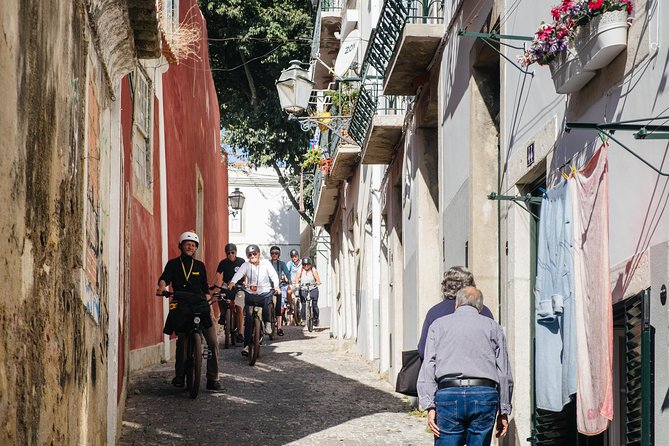
Next comes Museu do Fado, focused on Alfama’s connection to fado music. Even if you don’t go deep inside for long, the stop gives you a cultural handle for what you’re about to experience in Alfama’s streets—why certain lanes, atmospheres, and traditions get tied to the sound of fado.
This stop is short (around 5 minutes), and admission isn’t included. So think of it as a thematic waypoint: you’re learning why fado fits here, not treating it as your main museum day.
If music is a big reason you’re coming to Lisbon, you’ll probably want to follow up on the museum later on your own schedule—this tour gives you the thread, not the whole sweater.
National Pantheon (St. Engratia): a long build with big presence
Then you reach the Panteao Nacional, also known as St. Engratia Church. The scale and story are the draw. It’s a majestic baroque monument with a construction timeline that stretches from 1682 to 1966, and it serves as a resting place for major cultural and political figures in Portugal.
The stop is about 15 minutes, and the admission ticket for this area is marked free. Even if you don’t go inside for a full walk-through, you’ll still get enough time for the “wow” factor outside and some guide-led context.
This is a good moment in the ride to slow down mentally. By now the electric assist has started to feel like normal. The Pantheon stop resets your attention back to Portugal’s deep timeline.




Sao Vicente de Fora: monarchy stories inside a monastery
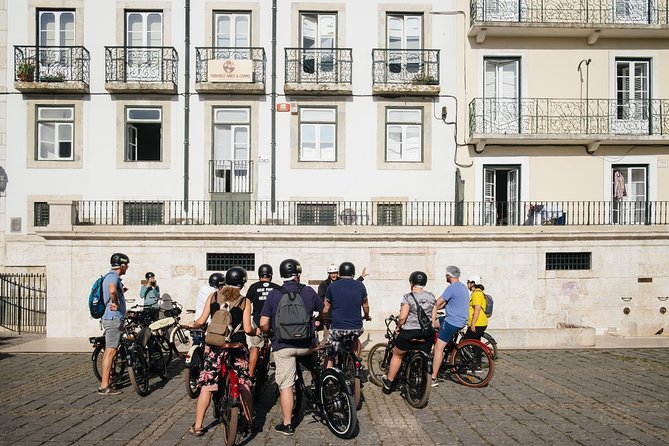
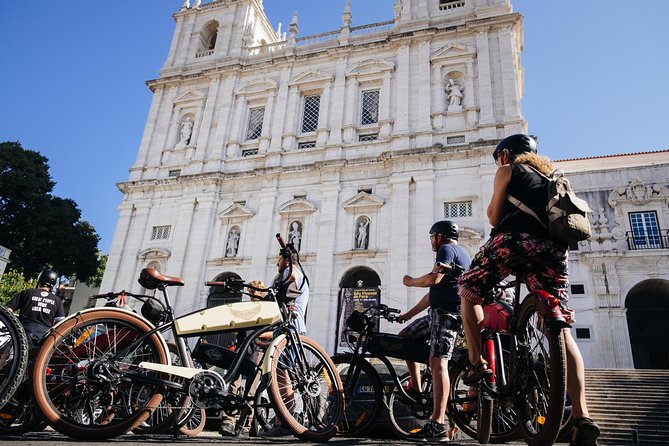
After that, you visit Mosteiro de Sao Vicente de Fora, one of Portugal’s important monasteries and mannerist buildings. There’s also a royal pantheon inside connected to the Braganza monarchs, so this isn’t only architecture—it’s also about how power and faith braided together over centuries.
The stop is about 10 minutes, and admission isn’t included. That means you can enjoy the exterior and guide context without committing to paid entry on the spot.
This stop also works well as a bridge toward the viewpoints. The ride begins to feel more vertical from here onward, with climbs and rest stops building toward the Graça area.
Graça viewpoints and the Tagus River drama
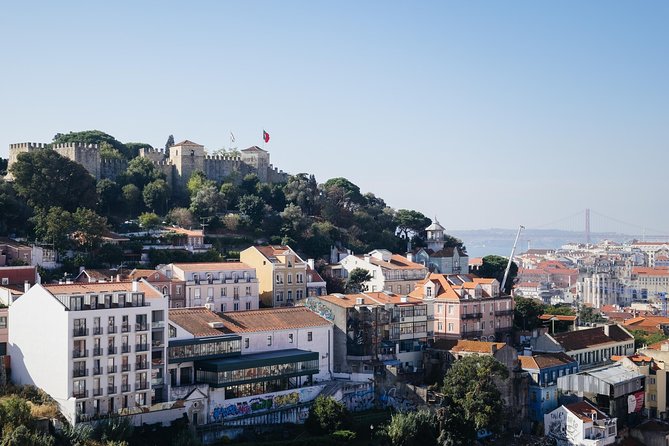
One of the highlights of this day is how it aims you toward Lisbon’s hilltop perspectives. At Miradouro da Graca (Sophia de Mello Breyner Andresen viewpoint), you’re in a neighborhood on the highest of the seven hills, close to the St. George Castle area. The guide uses this area to connect geography with history—how the hill shapes street patterns and how the river keeps pulling the city’s attention.
In the same general area, you’ll also connect to viewpoints such as Senhora do Monte and the Graça belvedere. The goal is simple: get you looking out over the city center and toward the Tagus with a proper sense of scale.
There’s also a mid-ride moment tied to the castle area. You’ll cross along the castle coast, then climb toward Graça to see a standout photo view of Lisbon Castle perched above the center. It’s the kind of moment that turns a map in your head into a real picture.
Practical note: viewpoint stops are short (around 10 minutes), so bring your camera ready and move with the group when it’s time to roll.
Alfama: medieval lanes, fado houses, and St. Anthony energy
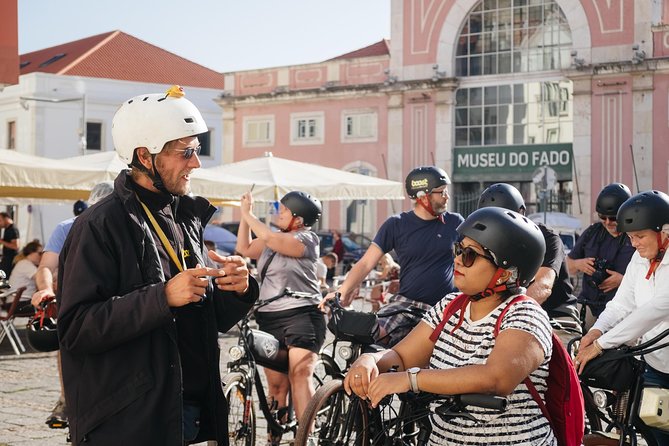
Next comes the heart of the ride: Alfama, Lisbon’s oldest neighborhood. This is the area of steep, cobblestoned lanes that still feel medieval in character. The guide ties the neighborhood to fado houses and to the June festivities honoring Santo António (St. Anthony), which bring huge crowds into the streets.
If you’re thinking Lisbon is only about grand squares and tiled facades, Alfama corrects that fast. You feel the neighborhood texture: staircases, narrow alleys, and that old Moorish atmosphere with everyday details like clothes drying on windows.
There’s about 30 minutes here, and that’s exactly enough time to understand why Alfama feels different from other districts. You’re not only “passing through.” You’re getting a real feel for how the neighborhood flows.
Also, this is one of the districts Lisbon’s authenticity is linked to surviving the 1755 earthquake. Whether you focus on that story for history or just enjoy the intact street character, it adds weight to the experience.
Lisbon Cathedral (Sé de Lisboa): oldest worship, thick walls, old power
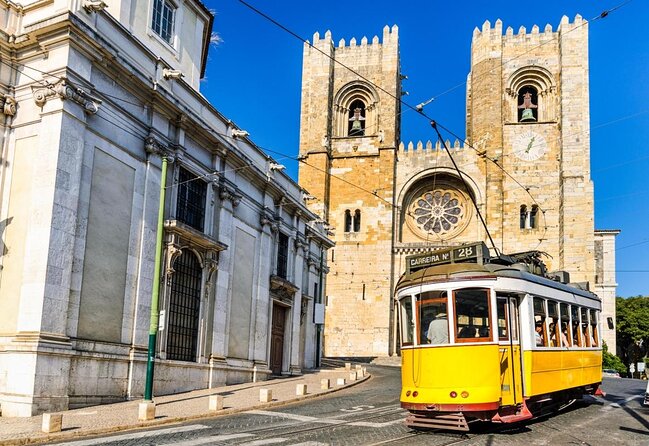
Then you reach Lisbon Cathedral, officially Santa Maria Maior de Lisboa. It’s described as the oldest place of worship in Lisbon, dating back to the mid-12th century.
Time-wise, you’ll have about 20 minutes. Admission is marked free, which makes this a comfortable stop if you want a little extra time with the building and less pressure about paying entry mid-ride.
I like this stop because it anchors the whole day in religious and civic continuity. It’s not just “pretty old church.” It’s a statement that Lisbon’s center has been forming and reforming itself for centuries.
Martim Moniz and the hill-crossing story
Another stop includes Praca do Martim Moniz. The square honors a nobleman tied to the 1147 conquest, linked to D. Afonso Henriques and a story about crossing a door so companions could pass through.
The stop is about 15 minutes, and admission isn’t included (this one is more about the setting and story than ticketed entry). You’ll notice that by the time you’re here, your day already has layers: riverfront beginnings, monarchy and faith landmarks, then the neighborhood maze of Alfama.
This is one of those moments where the guide’s storytelling helps you understand why Lisbon feels like it’s layered rather than built in one straight line.
Senhora do Monte: one of the highest views for city and river
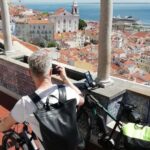
Finally, you return to a viewpoint at Miradouro da Senhora do Monte. This is about seeing Lisbon downtown and the Tagus River from one of the highest hills.
Admission is marked free, and the stop is around 15 minutes. This ending viewpoint works well because you finish the ride with perspective—looking back at the districts you just biked through and seeing how the city’s hills create natural separation.
If you’re the type who likes photos, this is often the point where everything you saw earlier clicks into place.
How the guide keeps the group safe on tight cobblestones
Small groups help, and this one is capped at 24 travelers. Still, the environment is challenging: narrow lanes, steep grades, and uneven old-stone surfaces.
The guides’ job is not just to talk. They manage spacing, group rhythm, and bike control reminders so you stay together. In the best runs, the guide also makes sure first-time e-bike riders feel comfortable with controls and start/stop behavior before the serious hill segments.
From the experience feedback I took seriously, guides like Peter and Camerone were praised for being attentive and keeping the energy positive, even when weather turned. João was also highlighted for taking time to walk people through the bike functions, especially for first-time riders.
Even with great guides, you should still respect the basics: ride at the pace of the group, don’t sprint downhill, and keep your focus on the road surface.
Price and value: what $30.23 covers (and what it doesn’t)
At about $30.23 per person for roughly 3 hours, the value is in how much ground you cover without draining yourself. You’re paying for the e-bike rental, the helmet, an adaptation lesson, and a local storytelling guide—all with insurance coverage and VAT included.
What you’re not paying for is monument entry fees. The tour notes tickets are not included. Some stops are marked free (like Praca do Comercio, Panteao Nacional, and Lisbon Cathedral), while others are not included (Museu do Fado and parts related to monasteries). So think of the price as paying for guidance, riding, and access to viewpoint-and-neighborhood time. If you want a full indoor museum or monastery visit, you may need to budget extra later.
Here’s the practical value math: if you’re trying to see Commerce Square, Alfama, cathedral area, and multiple viewpoints in one go, walking that route would likely take most of a day—plus you’d lose the ability to stop quickly for photos and context.
Who should book this e-bike tour
This tour is a great fit if you want an efficient way to see hilltop Lisbon districts and you’re okay riding on cobblestones. A moderate physical fitness level is suggested, and you don’t need prior e-bike experience, thanks to the setup lesson.
It’s also a smart choice if you’re limited on time and want a guided overview so you know what to revisit later. The combination of riverfront center, Alfama streets, and viewpoint endings gives you a strong “map in your head,” fast.
That said, this is not for everyone. A few riders mentioned bikes that felt tricky to handle on bumpy roads, and steep hills can still feel intense if you’re not comfortable biking in older city streets. If you feel tense around narrow spaces or have low confidence on uneven pavement, you’ll probably have a better time choosing a different style of tour.
Rain, timing, and what to pack
This tour runs in rain. The company provides ponchos, but slick cobblestones still demand care. Wear shoes with grip and plan for damp conditions. Your camera is worth protecting, but you’ll still get those viewpoint moments where the whole experience feels more dramatic in weather.
Timing is also worth noting. You should check in 15 minutes before your booked start time. And you’ll have a steady pattern of short stops—enough to absorb the story and grab photos, not enough to turn it into a long museum day.
If you’re booking during a busy season (like cruise ship days), expect more people in central areas. The route is still doable, just slower when you stop for traffic and crowd flow.
Should you book it?
I’d book this tour if you want a practical way to experience Alfama and Lisbon’s viewpoints without paying the full price in tired legs. The e-bike assist changes the day from a workout into a sightseeing rhythm, and the stops cover the kinds of places you’ll want to remember when you plan your next Lisbon walk.
Skip this only if you’re truly uncomfortable riding on uneven cobblestones or you know you get stressed in tight street situations. Lisbon’s streets don’t smooth out just because you have a motor helping you—so your comfort on a bike matters here.
If you do book, bring grippy shoes, listen carefully during the bike briefing, and treat the viewpoint stops like mini photo appointments: arrive ready, look around, then move with the group. That’s how you get the best “Lisbon hills” version of the day.
FAQ
Do I need prior experience riding an e-bike?
No experience is necessary. You’ll get an equipment adaptation lesson and a safety/operations briefing at the bicycle shop before you start riding.
What physical condition do I need?
The tour is for people with a moderate physical fitness level. You should also be confident bike riders because old town streets have steep hills and narrow lanes. There’s a minimum height of 1.5 meters and a maximum weight of 118 kg.
What’s included in the tour price?
Your price includes the electric bike rental, an equipment adaptation lesson, a helmet, an experienced local storyteller guide, liability and personal accident insurance, and all taxes (VAT 23%).
Are entrance fees to sights included?
Tickets or monument entrance are not included. Some stops are marked free, but others are not included, so you may want to budget for any paid entries.
Will the tour run if it rains?
Yes. The tour operates in the rain. The company provides ponchos, and you should dress for the weather conditions.
How big is the group?
The tour has a maximum of 24 travelers.
Can I cancel and get a refund?
Yes. Free cancellation is available up to 24 hours in advance for a full refund. Cancel within 24 hours of the start time and the amount paid is not refunded.