REVIEW · LISBON
Lisbon Bike Tour: Downhill Downtown Lisbon to Belém
Book on Viator →Operated by Lisbon Bike Tour Outdoors · Bookable on Viator
Lisbon is full of hills, so this ride feels like cheating. You start high at Parque Eduardo VII and spend the rest of the time rolling downhill and flat, with frequent stops to make sense of what you’re seeing. I like that you get a proper slice of central Lisbon and Belém without the traffic stress, and I also love the included pastry and local liquor that turn it into a real break, not just sightseeing.
Two more reasons it lands well: the route takes you past major landmarks in a way buses and trams don’t, and the small group size helps you actually hear your guide. The only drawback to plan around is the pace of storytelling versus riding time. A couple of people felt the guide could talk longer than they wanted, so if you prefer lots of quiet pedaling, keep that in mind.
You’ll finish in Belém, ready to keep exploring on foot or by whatever transport fits your next plan.
In This Review
- Key points I’d file away before you book
- Why a mostly downhill Lisbon to Belém route is such a smart idea
- Start at Alameda Cardeal Cerejeira and roll out before the crowds
- Parque Eduardo VII down to Marquês de Pombal: views plus the 1755 quake story
- Avenue of Freedom and the old-meets-new Lisbon feeling
- Praça dos Restauradores and Igreja de S Domingos: funicular and Jewish neighborhood context
- Praça da Figueira and the walkable value of Alfama stories
- Praça do Comércio (Terreiro do Paço): the big square that anchors the trip
- Cais do Sodré to the Tejo: river views, Cristo Rei, and the Ponte 25 de Abril
- Docas de Santo Amaro and MAAT: bridges, architecture, and a tech-meets-history vibe
- Padrão dos Descobrimentos and Torre de Belém from the outside
- What’s actually included (and how it changes the value)
- Bikes, kids, and who this tour fits best
- Small-group ride vibes: why the guide style matters
- Logistics that make your day easier
- Should you book this Lisbon bike tour to Belém?
- FAQ
- What is the duration of the Lisbon Bike Tour to Belém?
- What time does the tour start?
- Is the route uphill or downhill?
- Where does the tour start and end?
- What’s included in the price?
- What is not included?
- What group size should I expect?
- Is the tour offered in English?
- Can kids ride on this tour?
- What happens if the weather is bad?
Key points I’d file away before you book
- Mostly downhill and flat makes it beginner-friendly for a city that usually isn’t
- Helmet + bicycle rental included, plus insurance and a local guide
- Local liquor and pastry included, a nice mid-ride reset
- Belém payoff at the end so you can keep going after the tour
- Max 15 riders keeps the group manageable (and helps on photo stops)
- Landmarks like MAAT, Belém Tower, and the Discoveries Monument are seen from the outside
Why a mostly downhill Lisbon to Belém route is such a smart idea
Here’s the appeal in plain terms: Lisbon is gorgeous, but climbing is a real thing. This tour solves that by starting at the top and staying in a downhill/flat rhythm. That means you can focus on the views, the streets, and the landmarks instead of working your legs for every turn.
The best part is how the ride connects the dots between neighborhoods. You’ll move from central sights down toward the river and then keep heading into Belém, so the whole morning feels like a guided line across the city. It’s especially helpful on a first trip, when everything looks close on the map but somehow feels scattered once you’re actually walking.
It’s also a good match if you want the benefits of cycling—getting close to places, gliding past areas—without needing athletic stamina. You still need basic comfort on a bike, because Lisbon bike infrastructure is a mixed bag. Plan for some busy pedestrian/bike moments and stay alert.
You can also read our reviews of more tours and experiences in Lisbon.

Start at Alameda Cardeal Cerejeira and roll out before the crowds
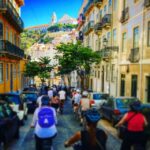
The meeting point is Alameda Cardeal Cerejeira, 1070-051 Lisboa, Portugal, with a start time of 9:30 am. You’re not starting in Belém; you’re starting just up the road from the energy of the city, which helps you get moving before the sightseeing crush really thickens.
The ride begins at the top of Parque Eduardo VII, which is an advantage all by itself. Starting high makes the “work” part easier—after that, the city works for you. And because you’re on bikes, you’ll cover ground fast enough to feel like you did something meaningful, but slow enough to stop often and actually learn what you’re looking at.
Bikes and helmets are included, so you can travel light. You don’t need to figure out rentals, sizing, or where to store your helmet for hours. Just show up, listen to the safety basics, and get rolling.
Parque Eduardo VII down to Marquês de Pombal: views plus the 1755 quake story
Your first big moment is leaving Parque Eduardo VII and heading into the center. This is where the downhill part really kicks in, and you’ll feel the payoff immediately: you’re moving through Lisbon without the constant braking and creeping you can get in walking tours.
Next you hit Marques do Pombal, a stop where the guide ties the area to the history of the 1755 earthquake. Even if you don’t memorize dates, these kinds of stories matter because they change how you read the city’s layout. You start noticing how Lisbon rebuilt and reimagined itself, which makes later landmarks hit harder.
A practical note: because the ride is easy, it’s tempting to relax too much. Don’t. Keep your eyes up for pedestrians and cyclists at crossings and along busier streets. The route is “easy” in terms of climbing, not in terms of being totally empty.
Avenue of Freedom and the old-meets-new Lisbon feeling
Between formal stops, you’ll pass the Avenue of Freedom, described as beautiful and green. It’s the kind of segment that breaks up the concentrated landmark moments, giving you a breath of space while still staying in the flow.
This part also hints at how wide Lisbon feels. You’re not just cycling through postcard squares. You’re seeing the city as movement: avenues, connections, and the way neighborhoods link together.
Praça dos Restauradores and Igreja de S Domingos: funicular and Jewish neighborhood context
At Praca Dos Restauradores, you’ll learn about the Glória Funicular. The stop is short, but the point is big: you’re understanding a city where steep terrain led to clever systems. Even if you never ride that funicular yourself, you’ll now recognize it as part of Lisbon’s survival strategy.
As you continue, you pass Rossio Square, then reach Igreja de S Domingos. This is where the tour adds real neighborhood texture, including the church’s ties to the old Jewish neighborhood. Stops like this are valuable because they don’t just say what a building is; they help explain who lived around it and how communities shaped the streets.
A drawback to consider here is time-on-the-clock. Several stops are quick, around a few minutes each, so if you want deep, linger-and-read exploration, plan to come back later. This tour is built to move, not to replace a museum day.




Praça da Figueira and the walkable value of Alfama stories
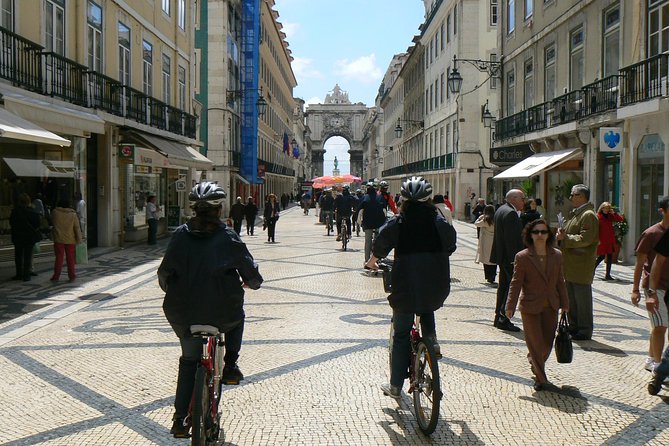
Then it’s Praca Da Figueira, where your guide shares stories connected to Alfama. You’re not just hearing generic Lisbon facts. You’re getting context that helps you understand why Alfama feels different from the rest of Lisbon—narrower streets, older layers, and a different pace of life.
This is also one of the nicer spots for photos, because the tour keeps you oriented. With a bike, you can grab the view and keep moving instead of spending your energy climbing to vantage points.
If you’re short on time in Lisbon, I’d treat this portion as your “get my bearings fast” moment. After this kind of narration, it’s much easier to decide which alleys you want to walk later.
Praça do Comércio (Terreiro do Paço): the big square that anchors the trip
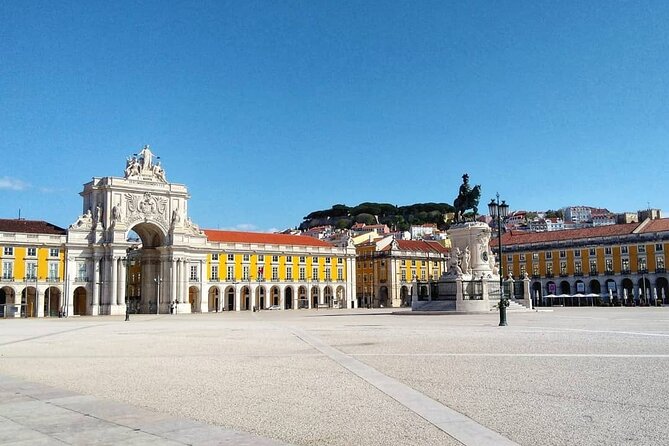
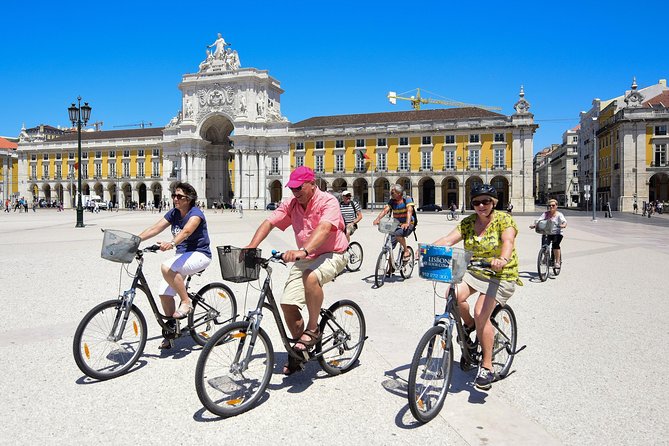
The ride lands at Praca do Comercio (Terreiro do Paco), described as Lisbon’s biggest square. This stop works because it’s a reset. You go from smaller streets and church context to an open urban stage where Lisbon feels official and grand.
More importantly, it’s a place you can visually connect to the river route you’ll take next. When you see how the city opens outward from here, the rest of the ride feels like a natural progression instead of a series of disconnected sights.
If you’re the kind of traveler who hates running from stop to stop without understanding why, this is where the tour earns its keep.
Cais do Sodré to the Tejo: river views, Cristo Rei, and the Ponte 25 de Abril
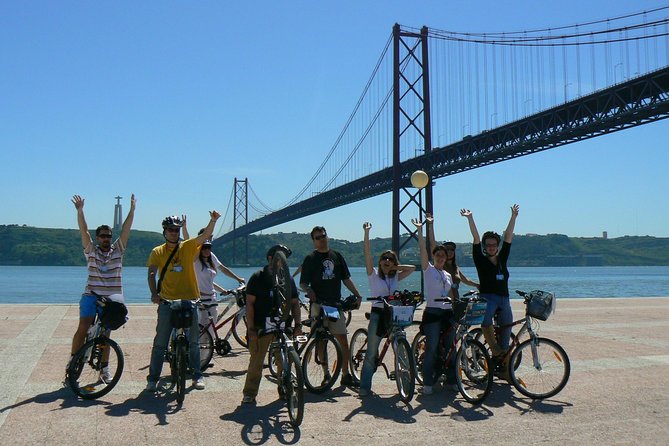
Next you roll to Cais do Sodre train station. The big payoff is the view of the Tejo river, plus the Cristo Rei statue and the Ponte 25 de Abril from the shore. This is the kind of scene you’d miss if you stayed purely in indoor museums or kept your route limited to central squares.
It’s also a smart use of cycling space. You’re in a position where you can take in a wide panorama, while still having a guide to point out what you’re seeing and why it matters.
Docas de Santo Amaro and MAAT: bridges, architecture, and a tech-meets-history vibe
From there you pass through Docas de Santo Amaro, with a guide explaining the April 25th Bridge. Then you glide past MAAT and an older powerplant setting. This is one of the moments that makes the ride feel modern and varied, not just historic sightseeing.
Even if you’re not an architecture person, these contrasts help. They show Lisbon as a living city that adds new layers while keeping older infrastructure close by.
One small consideration: if you’re sensitive to noise or busy waterfront pedestrian areas, be ready for the usual port-and-docks energy. Your guide will manage the group, but you’ll still be sharing space with people walking, waiting, and moving.
Padrão dos Descobrimentos and Torre de Belém from the outside
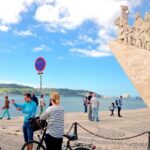
Near the end, you’ll see the Padrao dos Descobrimentos monument from the outside, with the guide covering history connected to Portugal’s Discoverer period. After that comes Torre de Belém, also from the outside, with UNESCO world heritage status noted.
These are listed as not included for admission, so you’re not paying during the tour for entrances. What you’re buying with this tour is time and access: you get the big landmarks framed by a ride that places you in the right place at the right moment.
If you want to go inside Torre de Belém or spend long hours on Belém’s waterfront, consider this tour as the kickoff. You’ll finish at Altis Belém Hotel & Spa, so you’re already in position to keep exploring.
What’s actually included (and how it changes the value)
For $47.79 per person, the value is built on what’s bundled, not what’s optional. You get:
- Bicycle use and a helmet
- Insurance
- A guide
- Alcoholic beverages (local liquor) plus snacks (local pastry)
That snack stop matters more than it sounds. It gives you a small reward that fits the rhythm of an outdoors ride. It also means you don’t need to hunt for food mid-tour or worry about costs snowballing.
The tour’s length is about 3 hours 30 minutes, and it runs with a small max group size of 15 travelers. In that time, you’re not just cycling; you’re getting an organized route with context at multiple points where you’d otherwise struggle to connect the dots on your own.
Bikes, kids, and who this tour fits best
This is designed for a wide range of riders. Most travelers can participate, and there are options for different needs: tag-a-longs with 20-inch wheel bikes, plus 24-inch wheel bikes, and child seats for ages 1 to 3 years and up to 22 kgs.
So if you’re traveling with kids, this tour makes a real case for itself. The key reason is the route profile: downhill and flat. Lisbon’s hills can be a deal-breaker for families, but this itinerary is structured to avoid that.
For adults, I’d say it’s best if you’re comfortable riding a bike around pedestrians and you want to move between sights without the stress of parking or traffic. One review noted the city’s bike infrastructure can be mixed, so keep your expectations practical: you’re getting a safe, guided experience, but Lisbon is still Lisbon.
Small-group ride vibes: why the guide style matters
The tour quality depends a lot on the guide’s narration style. Names that came up include Gina, George, Jorge/Joe, Vincent, Lara, John, Rachel, Gino, and Jorge again in a family context. The consistent thread: people loved the pacing and the way history showed up in stories, not just facts.
That said, one person felt there was too much talking and that it dragged. That’s a real consideration for your comfort. If you prefer a more active ride with shorter stops, you’ll want to choose your guide wisely if your booking options allow grouping preferences. If not, just go in expecting the narration to be part of the product.
Also: a practical nitpick popped up about bells being only on the guides’ bikes rather than all bikes. That’s worth taking seriously if you hate surprises around pedestrians. It’s not the tour’s biggest flaw, but if you rely on audible warnings, flag it with your guide.
Logistics that make your day easier
You finish in Belém at Altis Belém Hotel & Spa, which is helpful if your plan is to keep exploring Belém afterward. You avoid the energy crash of doing a big sightseeing ride and then immediately returning to the most central hotel area.
You’ll also be near public transportation at the start, which makes it easier to fit into a multi-day itinerary. Bring your expectations: this is an outdoors ride with included food and drink, so plan for no formal meal service beyond the snack.
If weather is rough, don’t plan to force it. This experience requires good weather, and you’ll be offered an alternative date or a full refund if canceled for poor weather.
Should you book this Lisbon bike tour to Belém?
Book it if you want Lisbon highlights with less hill pain and a clear route that moves from central sights to Belém. The price is reasonable because the essentials are bundled—bike, helmet, insurance, and a snack plus local liquor—and because you get views you’re unlikely to stitch together efficiently on foot.
Skip it or think twice if you really dislike guided talking during stops, or if you need a totally silent, self-paced experience. Also, if you’re not comfortable riding near people in busy areas, practice extra caution or consider a different sightseeing format.
If you’re arriving in Lisbon and want to beat jet lag while still feeling like you did something substantial, this is a strong first-day choice.
FAQ
What is the duration of the Lisbon Bike Tour to Belém?
It lasts about 3 hours 30 minutes.
What time does the tour start?
The start time is 9:30 am.
Is the route uphill or downhill?
It’s very easy, with no climb. The ride is always descending and/or flat.
Where does the tour start and end?
It starts at Alameda Cardeal Cerejeira, 1070-051 Lisboa, Portugal, and ends at Altis Belém Hotel & Spa, Doca do Bom Sucesso, 1400-038 Lisboa, Portugal.
What’s included in the price?
Included are bicycle use, insurance, guide, helmet, alcoholic beverage (local liquor), and a local pastry snack.
What is not included?
Admissions are not included for the Padrao dos Descobrimentos and Torre de Belém.
What group size should I expect?
The tour caps at a maximum of 15 travelers.
Is the tour offered in English?
Yes, it’s offered in English.
Can kids ride on this tour?
Most travelers can participate. Child seats are available for ages 1 to 3 years and up to 22 kgs, and there are tag-a-longs with 20-inch wheel bikes as well as 24-inch wheel bikes.
What happens if the weather is bad?
This experience requires good weather. If it’s canceled due to poor weather, you’ll be offered a different date or a full refund.