REVIEW · ROME
Appian Way Aqueducts Bike Tour with Catacombs & Lunch
Book on Viator →Operated by Roma STARBIKE · Bookable on Viator
Rome’s ancient road is best on two wheels.
This Appian Way e-bike tour strings together major sights—catacombs, aqueduct parks, and big-name ruins—without turning the day into an endurance test. I especially like how the route adds smart stops you usually miss when you only do street-level Rome, and how guides keep the story moving with real, on-the-ground context.
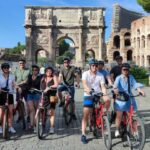
Second, I like the practical setup for comfort and control: you get an e-bike plus a helmet and phone/handlebar holders, and the tour runs with a small group so you’re not constantly waiting. One drawback to factor in: the Appian Way includes cobblestones, and you should plan for some bumpy moments (and possible saddle soreness), especially in hot weather.
In This Review
- Key things I’d zero in on
- Why An E-Bike Makes the Appian Way Feel Doable
- Your Small-Group Setup at Roma STARBIKE
- Porta San Sebastiano: Rome’s Southern Gateway and the Start of the Story
- San Callisto Catacombs: An Underground Visit You Can’t Fake
- Parco della Caffarella to Ninfeo di Egeria: Green Rome, Ancient Drama
- Cecilia Metella’s Mausoleum and Castrum Caetani: The Appian Way’s Photo Magnet
- Lunch or Aperitif by the Aqueducts: Fuel, Timing, and Reality Checks
- Parco degli Acquedotti: The Best Place to Understand Roman Water
- Villa dei Quintili to Santa Maria Nova: Big Names, Short Stops
- Caracalla’s Baths and the Circus of Maxentius: Two Quick Legacies
- What the Ride Feels Like: Cobblestones, Heat, and Comfort Tips
- Price and Value: What $107.41 Buys You Here
- Should You Book This Appian Way E-Bike Tour?
- FAQ
- How long is the Appian Way Aqueducts Bike Tour with Catacombs & Lunch?
- What is the price per person?
- Is the tour in English?
- What’s included with the bike and safety gear?
- What food is included: lunch or an aperitif?
- Is the catacombs visit guided?
- Are any sites free for entry on this route?
- What fitness level do I need?
- What is the maximum group size?
- Can I cancel for free?
Key things I’d zero in on
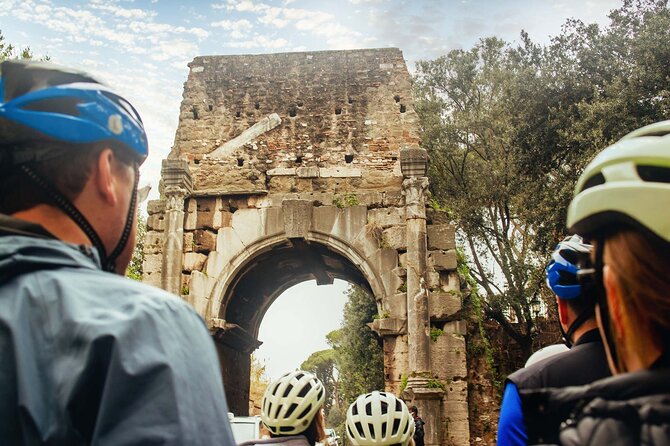
- San Callisto catacombs with a guided visit included, plus official tickets handled for you
- Cobbled Appian Way segments where the e-bike helps, but you still feel the road
- Aqueduct parks + Roman engineering in a quieter green setting away from the city core
- Lunch or aperitif included, timed to match the tour slot (morning lunch, afternoon aperitif)
- Max 12 people, which usually means faster decisions, more attention, and better group control
Why An E-Bike Makes the Appian Way Feel Doable
The Appian Way isn’t just a pretty road. It’s a whole corridor of Rome—gateways, cemeteries, parks, villas, baths, and aqueduct remnants—stretched out along what used to be one of the empire’s most important routes. On a regular bike (or on foot), that can turn into a slow, exhausting shuffle.
On an electric bike, the goal flips: you get movement and momentum, so you can actually take in the scenery and the details. The day is built around short visits—usually 15 to 50 minutes—so you’re not constantly in transit. And because the stops are clustered along the same ancient spine, you’re spending your time where the story lives, not wasting hours bouncing between far-flung neighborhoods.
The practical plus: e-bikes help on inclines and longer stretches, so you spend less energy on just getting from A to B. That matters here because you’re on a route that includes uneven ground, not smooth bike paths.
You can also read our reviews of more tours and experiences in Rome.



Your Small-Group Setup at Roma STARBIKE
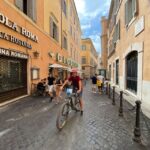
The tour starts back at Roma STARBIKE in central Rome, at Via dei SS. Quattro, 58. It’s convenient, and the activity ends back at the same meeting point.
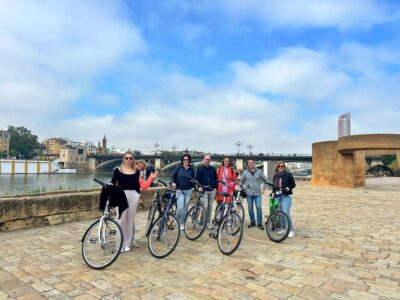
The group stays small—a maximum of 12 travelers—and that’s not just a feel-good number. With this format, a smaller group usually means:
- you get clearer bike guidance before you roll out,
- you stay closer together on slower or tricky sections, and
- your guide can check in if someone wants to push for comfort.
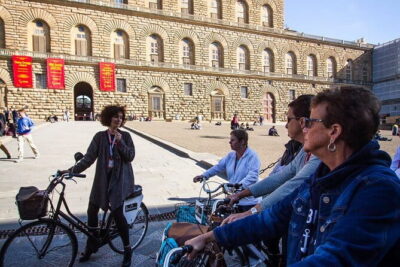
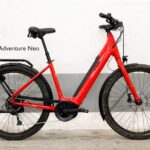
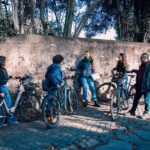
You also get the gear that makes a big difference on a half-day ride: helmet, a high-quality e-bike, plus holders for your mobile phone and for items on the handlebar. There’s also a child seat option (up to 25 kg), and a trailer-bike setup for children 6–10 only when they’re under 143 cm, since they ride with a trailer rather than a separate e-bike.
One key requirement: you must know how to ride a bike well, and the tour expects moderate physical fitness. It’s not a steep workout, but it is a 5-hour activity with real riding time.
Porta San Sebastiano: Rome’s Southern Gateway and the Start of the Story
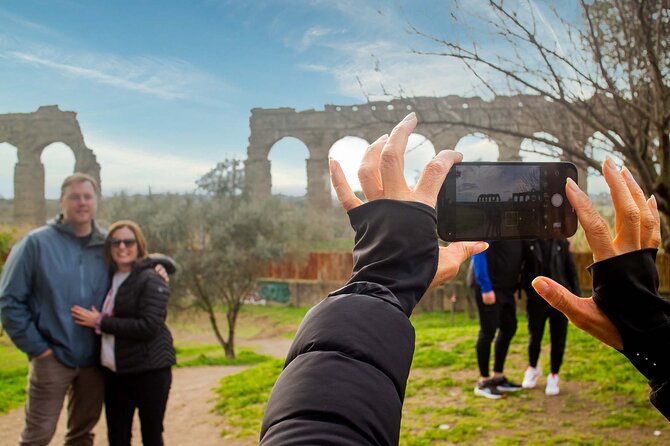
You begin at Porta San Sebastiano, an imposing southern gate in the Aurelian Walls, built around 275 AD. This isn’t just a dramatic backdrop. It marks the beginning of the historic Via Appia Antica, so the tour starts in the right place—where the road turns from city streets into the ancient route you came to experience.
What I’d look for here is the “layers” feeling: the gate connects ancient Rome’s fortification era with medieval foot traffic. The medieval graffiti is part of that living texture. It’s one of those moments where you can quickly shift your brain from sightseeing to story mode: you’re not just looking at ruins—you’re seeing evidence of people moving through this same corridor for centuries.
Even though the stop is short (about 15 minutes), it sets your mental map for what comes next.
San Callisto Catacombs: An Underground Visit You Can’t Fake
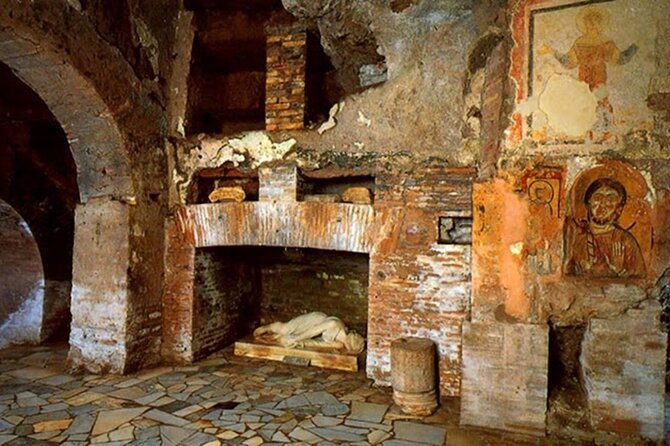
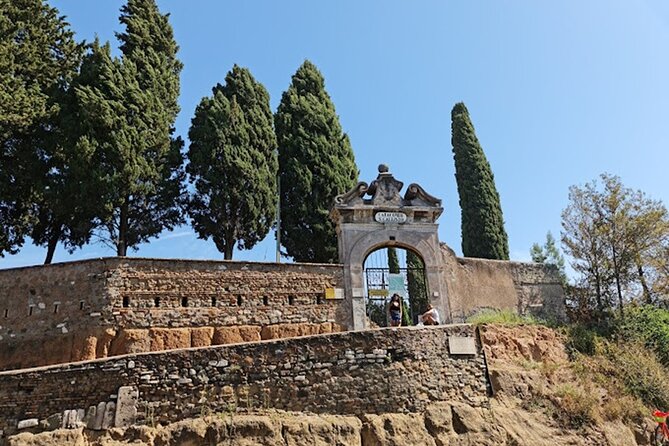
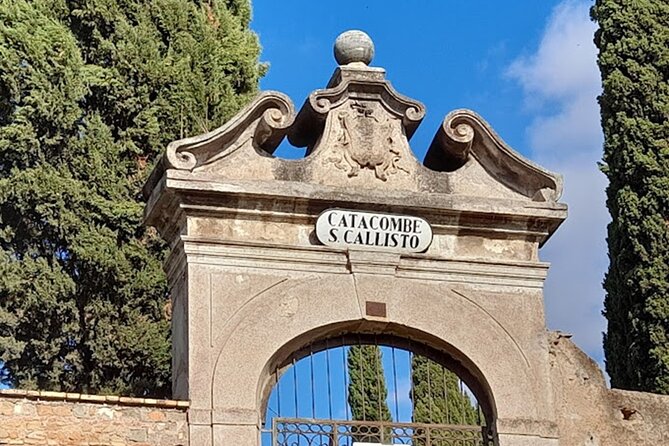
The catacombs are the heavy-hitter on this tour schedule. You go to Catacombe di San Callisto, the official funerary complex tied to the Church of Rome. It’s known as the largest underground cemetery in the city, with corridors that can reach about 20 km.
The St. Callixtus catacombs date back to the second century BC, and they take their name from Deacon Callixtus I. The scale is part of why this stop hits: you’re talking about a burial site connected with over 50 martyrs, 16 popes, and around half a million Christians.
You get admission included and a guided visit of the catacombs. Your guide also takes care of tickets, then you’re guided into the underground space by an official catacombs guide.
A practical note: if you’re sensitive to tight, dim spaces, plan to take it slowly. Catacombs are not about wide open views. They’re about atmosphere, history, and the sense that you’re walking through the edge of faith, family, and fear that shaped Rome for centuries.
Expect roughly 50 minutes for this stop, and keep your energy steady—you’ll be back on the bike after.
Parco della Caffarella to Ninfeo di Egeria: Green Rome, Ancient Drama
After the underground portion, you roll into Parco della Caffarella. This park is tied to the Appia Antica Regional Park and is one of the biggest green spaces in the region of Rome and beyond. The big win is that you’re seeing the countryside side of Rome in a way that feels calmer than the city core.
This area also carries remnants of ancient buildings, tucked into paths and groves. That means your photo stops aren’t random. They’re positioned where the ground itself still hints at what was here.
Then comes a smaller, story-forward stop: the Ninfeo di Egeria. It’s described as sacred ground tied to the love story between the nymph Egeria and Numa Pompilius, the second king of Rome. The legend says Egeria’s grief after Numa’s death turned into a spring.
This is the kind of stop that works best if you let it be small. Don’t force it to be a major landmark. Instead, treat it like a chapter break: a brief pause that changes your tone from engineering and empire into myth and meaning.


Cecilia Metella’s Mausoleum and Castrum Caetani: The Appian Way’s Photo Magnet
Next is Mausoleo di Cecilia Metella and Castrum Caetani in the Appia Antica archaeological park. This is a pagan tomb dedicated to Cecilia Metella dating to the 1st century BC, and it’s known as one of the best preserved mausoleums along the Via Appia Antica.
The mausoleum is built into the Castrum Caetani, a fortified complex. You can also see remnants of the medieval house of the wealthy Caetani family and the church of San Nicola, with only perimeter walls still standing. That blend matters: you’re looking at an ancient monument that outlasted its original purpose and got absorbed into later eras.
The stop is short (around 20 minutes), so come ready for quick scanning and detail spotting. If you like Roman funerary architecture, this is one of the more satisfying stops because it’s solid, readable, and still visually powerful.
Lunch or Aperitif by the Aqueducts: Fuel, Timing, and Reality Checks
You’ll ride next to the Park of the Aqueducts, where the tour includes a scheduled break with lunch. There’s a note that the timing depends on your tour slot: in the afternoon, you get a tasty aperitif instead of lunch.
So think of this as two possible experiences:
- Morning tours: lunch + water
- Afternoon tours: cold cuts + drinks (aperitif-style)
Either way, it’s designed to keep you from hitting a wall after catacombs and multiple park stops.
Now, the realistic part. Some people find the included food simple and more like sandwiches than a full sit-down Roman meal. If you’re the type who cares a lot about lunch quality, I’d still go in with flexible expectations: the value here is the combination of sites plus the bike riding, not gourmet dining.
Still, it’s timed well—mid-tour, before you push deeper into the aqueduct park area. It’s also practical: it keeps your day flowing instead of forcing you to hunt for food.
Parco degli Acquedotti: The Best Place to Understand Roman Water
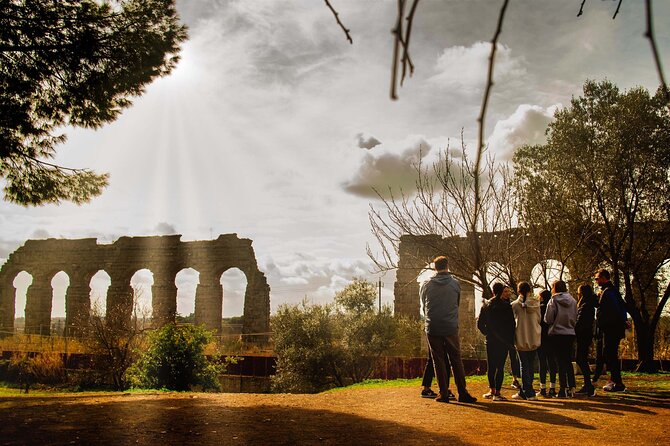
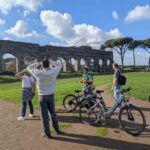
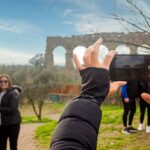
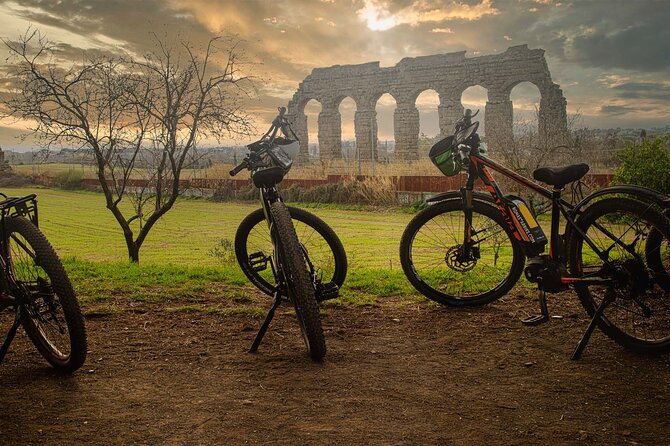
After the meal break, you continue by e-bike through Parco degli Acquedotti, part of the Appia Antica archaeological park. This is a huge green area crossed by the ancient water network of Rome.
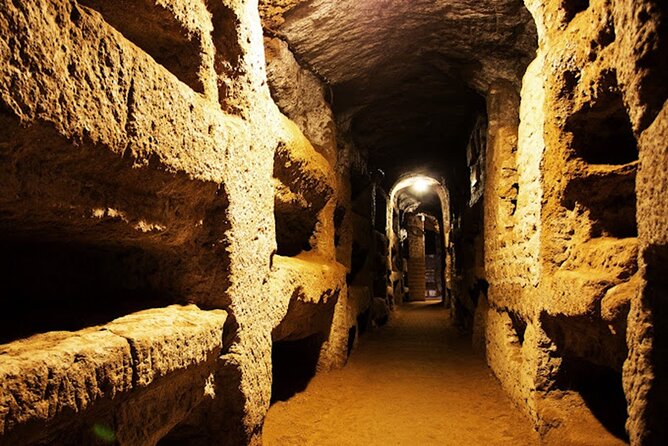
This is where the tour really helps you connect the dots. Aqueducts can sound like trivia when you read about them in a museum. Here, you see remains in context—some parts well preserved and, in some places, still in operation. That detail is a big deal. It turns Roman engineering from a concept into something you can actually point to in the landscape.
The stop runs about 50 minutes. You’ll typically pause for views and photos, and your guide helps you make sense of what you’re seeing as you move. The cycling adds variety: you’re not stuck staring at one spot for the whole time.
If you like engineering, Roman infrastructure, or just the feeling of being in open air while history stays close, this is a strong mid-to-late highlight.
Villa dei Quintili to Santa Maria Nova: Big Names, Short Stops
Next up is Villa dei Quintili and Santa Maria Nova, around the fifth mile of the Appian Way. You’re in the area of the villa belonging to Sesto Quintilio Condiano and Massimo Valerio, consuls in the 2nd century AD.
The background detail that makes it interesting: they were killed by Commodus I, who then confiscated the villa and made it imperial property. You’re looking at ruins with a clear political storyline behind them, not just “old stones.”
The stop is about 20 minutes, so you’ll want to use that time to connect the remains to the broader Appian Way theme: this wasn’t only a road of travel. It was also a zone of villas, power, and landholding.
Caracalla’s Baths and the Circus of Maxentius: Two Quick Legacies
The last stretch pulls you back toward monumental ruins with short, efficient visits.
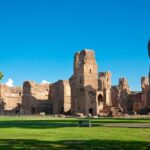
First: Terme di Caracalla (Baths of Caracalla). Built by Emperor Caracalla, these baths were for about a century the largest public baths ever built, and a lot of the structure still survives. Water came to the baths via the Aqua Marcia, carried through the Antoninian aqueduct. You can even see small remains at Porta San Sebastiano earlier on the route.
Then: the Circus of Maxentius. Located on Via Appia Antica, it’s considered one of the best-preserved Roman circuses. The spina (the central divider area) is still visible. There’s also a neat afterlife to remember: during the Renaissance, the Agonale obelisk was moved to Piazza Navona’s Fountain of the Four Rivers.
These stops are brief (about 15 to 20 minutes each), but they work because you’re ending with big, recognizable Roman “wow” elements. You finish the ride having touched religion, infrastructure, luxury, and public entertainment.
What the Ride Feels Like: Cobblestones, Heat, and Comfort Tips
Here’s the part you should plan for. The Appian Way includes cobblestones, and you’ll feel it. The ride isn’t just smooth strolling through parks. There can be a longer section of original, uneven cobbles—roughly a kilometer is called out as the toughest stretch by riders—so it can be bone-rattling.
The e-bike helps, but you still get the vibration. That’s also why pacing matters: you might ride slowly through certain segments, or you may choose to push at times for comfort. Your guide should prepare you for the challenging portion before you hit it, and that preparation helps your nerves.
Saddle soreness is another real-world issue. Some riders noted saddles aren’t the most forgiving on cobblestones. If you’re even slightly prone to discomfort after bike rides, bring a simple saddle cover or consider packing your own comfort gear. It’s small, but it can save your second half of the day.
Heat can also turn a good day into a slog. The route is partly outdoors and partly in open areas around the parks. If you’re traveling in summer, plan for water intake, pace your breaks, and avoid pretending you’re in shade all the time.
Price and Value: What $107.41 Buys You Here
At about $107.41 per person for roughly 5 hours, you’re paying for a lot of coordination and included value:
- e-bike and safety gear
- lunch + water or an afternoon aperitif option
- catacombs admission handled with a guided visit
- a guided route along multiple major Appian Way sites
- a small-group format (max 12)
For Rome, where you can easily spend half a day commuting between separate tickets and separate entrances, the combined package matters. You’re also getting a countryside-style experience: aqueduct parks and villa/bath/circus ruins without spending your entire day fighting traffic or walking miles.
Is the lunch extravagant? Not really. But the tour’s value is the full arc of history plus the bike access. If you want your day to feel like a curated ride rather than a checklist you manage yourself, this is good value.
Should You Book This Appian Way E-Bike Tour?
Book it if you want:
- an e-bike way to cover a chunk of the Appian Way without grinding your legs raw,
- included catacombs with a guided visit,
- aqueduct parks and Roman infrastructure in a quieter setting, and
- a small group where your guide can keep the route smooth.
Skip it or reconsider if:
- you hate cobblestones or vibration,
- you’re expecting a fully cushioned bike-ride experience, or
- food quality is your top priority (the included meal is more practical than fancy).
If you’re comfortable biking well and you’re okay with some bumpy moments, this is one of the better half-day ways to understand Rome beyond its usual postcard zones.
FAQ
How long is the Appian Way Aqueducts Bike Tour with Catacombs & Lunch?
It runs about 5 hours (approx.).
What is the price per person?
The price listed is $107.41 per person.
Is the tour in English?
Yes, it’s offered in English.
What’s included with the bike and safety gear?
You get a high-quality e-bike, a helmet, and holders for your mobile phone and handlebar items. If traveling with a child, there is also a child seat option.
What food is included: lunch or an aperitif?
The tour includes lunch + water in the morning. In the afternoon, lunch is replaced by an aperitif with cold cuts and drinks.
Is the catacombs visit guided?
Yes. The tour includes a guided visit of the catacombs.
Are any sites free for entry on this route?
Some stops list admission ticket free (like the parks and several outdoor sites), while the catacombs admission is included.
What fitness level do I need?
You should have a moderate physical fitness level. You also must know how to ride a bike well.
What is the maximum group size?
This tour has a maximum of 12 travelers.
Can I cancel for free?
Yes, you can cancel for a full refund up to 24 hours in advance of the experience start time.