REVIEW · ROME
Appian Way and Aqueducts Electric Bike Tour
Book on Viator →Operated by Easy Bike Rent Rome · Bookable on Viator
Trade crowds for quiet Roman roads. This Appian Way and Aqueducts electric bike tour turns Rome into a walkable-feeling time machine, with an e-bike that makes the trip doable without wrecking your day. I especially loved the storytelling from guides like Adriana and Monica, and how the ride ties together places you normally see one at a time.
You get a compact route through major ruins and special landscapes: Circo Massimo, the Baths of Caracalla, the Appian Way gates and cemeteries, then parks built around the aqueducts. One thing to think about: the surfaces can be rocky and bouncy, so you’ll want basic bike comfort and a moderate fitness level.
In This Review
- Key things that make this e-bike Appian Way tour worth your time
- Appian Way by e-bike: a half-day that changes how you see Rome
- Meeting point, bikes, and what to expect from the ride
- Circo Massimo and Porta San Sebastiano: Roman spectacle, built on a valley
- Baths of Caracalla and the Appian Way catacombs: religion, power, and underground quiet
- Circus of Maxentius and the Cecilia Metella tomb: turning corners into monuments
- Villa dei Quintilii and the aqueduct parks: where the Appian Way turns green
- Ninfeo di Egeria: how the guide ties folklore into place
- Price and value: what $90.02 really buys for a 4-hour Rome experience
- Who should book this Appian Way and aqueducts e-bike tour
- Should you book this Appian Way e-bike tour?
- FAQ
- FAQ
- How long is the Appian Way and Aqueducts electric bike tour?
- Where does the tour start?
- Where does the tour end?
- Is the tour offered in English?
- What is included in the price?
- What is not included?
- Are admissions to all stops included?
- How many people are in each group?
- Do I need to ride a bike before?
- Is there an age recommendation?
- Can I cancel for a refund?
Key things that make this e-bike Appian Way tour worth your time
- E-bike support makes the Appian Way feel reachable even when the route gets uneven
- Small group size (max 10) keeps it calm and easier for the guide to manage
- Ancient sites are paired with real cycling routes, not just quick photo stops
- Multiple major landmarks on one ride, including Circo Massimo, Porta San Sebastiano, and the catacombs
- Free admission for several stops, while a few key sites may require extra tickets
- Guides with strong English skills (seen with Adriana, Monica, and Monika) help the history land fast
Appian Way by e-bike: a half-day that changes how you see Rome
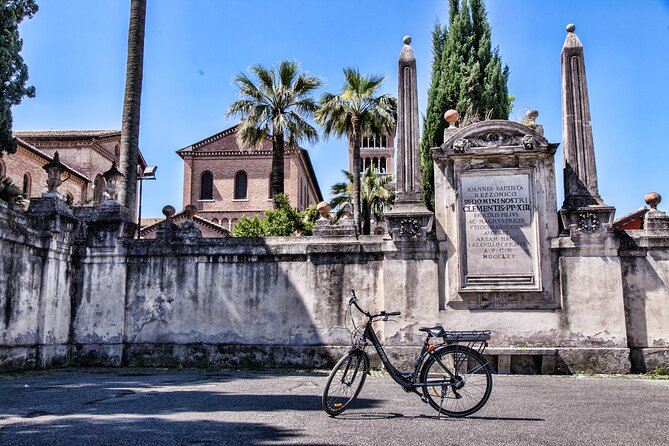
Rome can be great in huge doses. But after a few hours in the center—lines, noise, heat—you start craving space. This tour gives you exactly that: you pedal out from the busiest streets and into a Roman world where stone roads, aqueduct remains, and park valleys do the talking.
The e-bike matters. Even if you’re not chasing speed, you want enough assist to keep your energy for the stops—especially when you’re going between big-ticket sights like Circo Massimo and the Appian Way’s underground spaces. This is why it feels different from a bus day. You’re moving at a human pace, so each place clicks into place.
And then there’s the guide factor. In the best moments, your guide doesn’t just list facts—they connect the dots. Guides like Adriana and Monica are praised for clear English and an organized flow that makes you feel safe navigating out beyond central Rome. That matters in Rome, where traffic and narrow streets can turn a normal walk into a headache.
You should go in with the right expectations: this isn’t a gentle parade on perfect pavement. The ride can be physically a bit demanding, and some sections are described as rough. Still, that’s also part of the payoff. You’re not just looking at ruins—you’re traveling through the setting they shaped.
You can also read our reviews of more tours and experiences in Rome.



Meeting point, bikes, and what to expect from the ride
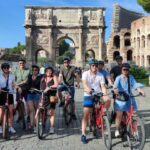
You start at Via dei Cerchi, 59, 00186 Roma RM, and the tour ends back at the same point. You’ll use a mobile ticket and ride with an English-speaking guide. Group size is capped at 10, which usually means you get more attention during bike setup and turning points.
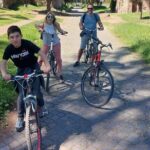
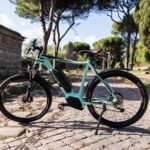
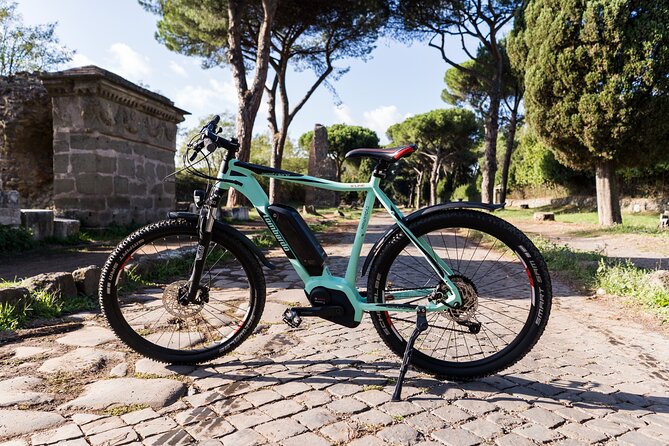
Bikes are provided in several sizes, along with a helmet and a phone holder. That combination is practical. A helmet makes sense on mixed surfaces, and the phone holder is handy if you want to keep your bearings while your guide works the route.
Because the tour is built for cycling along the Appian Way and through parks, you should show up ready to ride. The tour is listed for people with moderate physical fitness, and it’s not recommended if you don’t know how to bike. One review also flags that you need to be able to handle rougher terrain, since the ride can be bouncy.
What I’d do on your prep list:
- Wear shoes with grip (the Appian Way can mean stone and uneven patches)
- Plan on taking it slow when the surface changes
- Don’t treat this like a casual cruise on smooth roads
If you’re a first-time e-bike rider, you’re not automatically doomed. Several guides get called out for making the bikes easy to use. Just be honest with yourself: if the idea of balancing on imperfect ground stresses you out, you’ll enjoy it more with some practice before your tour.
Circo Massimo and Porta San Sebastiano: Roman spectacle, built on a valley
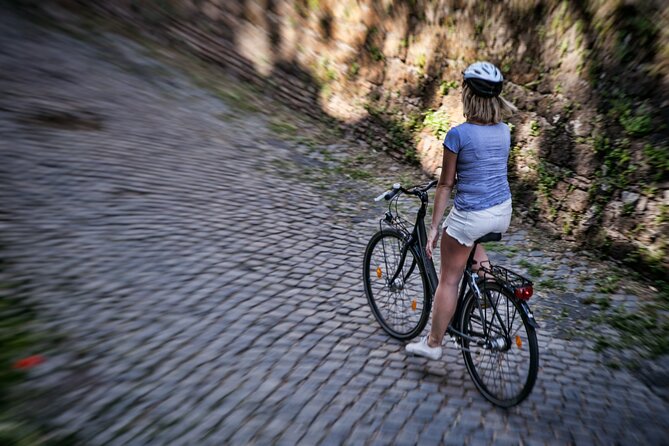
The tour kicks off with Circo Massimo, the Circus Maximus. This isn’t a tiny ruin you can skim past. It’s huge even when it’s mostly gone.
Here’s what makes Circo Massimo a smart first stop: it gives you the context for how Romans spent their public energy. It’s in the valley between the Aventine and Palatine hills, and it was the first and largest chariot-racing stadium in ancient Rome. The scale is staggering: 621 meters long and 118 meters wide, with an estimated capacity of over 150,000 spectators.
From your bike, you get a sense of scale that’s hard to recreate from street level alone. Plus, by starting with entertainment architecture, the rest of the tour makes more sense—because you’ll keep seeing how Rome organized life around monumental spaces.
Next comes Porta San Sebastiano, the Aurelian Walls gate. This is one of the largest and best-preserved gates along the city’s defensive walls. Gates like this are more than entrances; they’re time capsules of how Rome controlled movement. You can also feel the shift from the dense core of Rome toward the road that leads outward—an important mental transition when you’re about to ride the Appian Way region.
If you care about atmosphere, this pairing works. The circus shows Roman spectacle. The gate sets up Rome’s edge.
Baths of Caracalla and the Appian Way catacombs: religion, power, and underground quiet
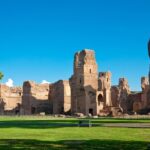
Then the tour moves to Terme di Caracalla (the Baths of Caracalla). These were Rome’s second-largest public baths, built in the early 3rd century during the reigns of Septimius Severus and Caracalla. The baths were likely built around AD 212 (or 211) and operating into the 530s before falling into ruin.
Why this stop is worth your attention on an e-bike tour: baths weren’t only about cleanliness. They were social centers—places where citizens gathered, argued, relaxed, and displayed status. Seeing them while you’re already out on the Appian Way route helps you understand that “out of the city” didn’t mean isolated. Roman power was everywhere.
One note for your planning: admission to the Baths of Caracalla is not included in the tour price. The tour lists it that way, so you should expect extra ticket handling here.
From there, you ride toward the Catacombs of Saint Callixtus (Catacombs of Callixtus). This is one of the Catacombs on the Appian Way, and it’s located in a very nice, almost pedestrian area—so you’re not constantly fighting for space while you switch from cycling to visiting.
Catacombs can feel like a totally different Rome than the one with giant stadiums and wall gates. That contrast is part of the value. One moment you’re thinking about crowds and events; the next you’re in a site tied to burial and early Christian history. Even without deep technical background, the shift in mood makes the tour feel like a complete slice of ancient life.
Circus of Maxentius and the Cecilia Metella tomb: turning corners into monuments
After the catacombs, you’ll visit the Circus of Maxentius. This ancient structure sits as part of a larger complex built by Emperor Maxentius along the Via Appia between AD 306 and 312. It’s another reminder that the Appian route wasn’t only a road—it was lined with powerful buildings and elite influence.
If you like Roman architecture with “who built this and why?” energy, this stop helps. The circus is tied to a specific emperor and time period, so it feels more grounded than general sightseeing.
Next, you’ll reach the Mausoleo di Cecilia Metella and Castrum Caetani area, inside the Parco Archeologico dell’Appia Antica. The tomb of Caecilia Metella is one of the most well-known and best-preserved monuments along the Via Appia. It was built in the 1st century BC to honor Caecilia Metella, the daughter of Quintus Caecilius Metellus Creticus.
This is one of those places where the scale and silhouette do the work even if you don’t memorize every date. Tombs like this are built for visibility and longevity. It’s also a good spot to look around and see the Appian Way setting—because the surrounding context is part of why this region is so special.
Just like the baths, admission at the Cecilia Metella tomb area is listed as not included, so factor in possible extra ticket time.


Villa dei Quintilii and the aqueduct parks: where the Appian Way turns green
Another major stop is the Villa dei Quintilii and Santa Maria Nova, again within the Parco Archeologico dell’Appia Antica. The Villa of the Quintilii sits beyond the fifth milestone along the Via Appia Antica. It was built by the wealthy Quintilius brothers: Sextus Quintilius Valerius Maximus and Sextus Quintilius Condianus—consuls in 151 AD.
The key value here isn’t only the building itself. It’s the fact that this is “out there” Rome—where you can see how wealth lived at the edge of the city. A villa complex makes the road feel alive, not just like a paved path between monuments.
Admission is also listed as not included for this stop.
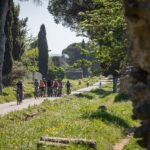
After that, the tour spends time in Parco degli Acquedotti, the Aqueduct Park. This is where cycling really becomes the point. The park is named for the aqueducts, and you can see Aqua Felix on one side, plus part of Aqua Claudia. There are also remains of Villa delle Vignacce to the northwest, and you can spot a short stretch of the original Roman Via Latina.
This is a huge advantage of doing it by e-bike. From a parked viewpoint, you’d miss how the aqueducts and ruins sit inside a lived-in green area. On the bike, you get forward momentum and changing angles—so you understand the layout instead of just collecting shots.
The next green-breath stop is Parco della Caffarella. It’s a large park in the heart of Rome, part of the Parco Regionale Appia Antica. The Caffarella Valley is bordered by Via Latina to the north and the Appian Way to the south. In other words, you’re in a natural corridor shaped by the road network.
One review even mentions passing goats and sheep in the area, which tells you the tone here isn’t purely museum-quiet. It’s Roman countryside within city reach.
Expect some bumpy sections because this is a real path environment, not a theme park trail. Still, this is where the tour feels most like a break from central Rome.
Ninfeo di Egeria: how the guide ties folklore into place
The ride ends with the Ninfeo di Egeria. Egeria is the nymph linked to early Roman legend, connected to Numa Pompilius, the second king of Rome. In the story, Egeria plays a divine counselor role, imparting laws and rituals tied to Roman religion.
This stop is a clever finisher because it changes your relationship to the ruins. Instead of only seeing stone and engineering, you hear a story that explains why people made meaning around natural features and myth.
Also, her name became an eponym for a female advisor or counselor, which is a fun little cultural echo your guide may point out. It helps the site feel less like trivia and more like how Rome built explanations for its own identity.
Price and value: what $90.02 really buys for a 4-hour Rome experience
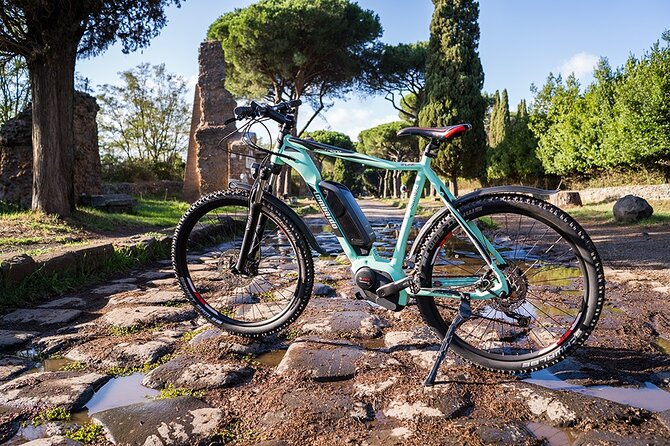
At $90.02 per person for about 4 hours, this tour competes well with the cost of separate admissions and transport. What you’re paying for is a guided route plus a real bike experience, not just a list of stops.
Here’s the practical breakdown of value:
- You get an electric bike in several sizes, a helmet, and a mobile phone holder
- You get a guide in English
- You visit a stacked set of major sites tied to the Appian Way region, including places where admission is free and others where it isn’t
Food and drink are not included, and tips aren’t included either. That’s normal for tours like this. I’d plan to budget for at least a quick snack or water, especially in warmer months. One review notes that there were drink stops on a hot day, but you shouldn’t count on meals being part of the plan.
One logistics-plus: the tour runs with a maximum of 10 travelers. That’s not a huge deal-maker everywhere, but on bikes through mixed terrain, smaller groups tend to feel safer and more orderly.
And finally, the bike is doing more than helping you pedal. It gives you time to slow down at the sites that matter, like porta gates, stadium scale, and the aqueduct parks, instead of losing half your effort to transit.
Who should book this Appian Way and aqueducts e-bike tour
This tour is a great fit if you:
- Want a half-day change of scenery outside central Rome
- Like seeing ruins with context, not just photo stops
- Feel comfortable riding a bike and can handle uneven ground
- Want the Appian Way region in one coordinated ride
It may not be the best match if you:
- Don’t know how to ride a bike (it’s not recommended)
- Have trouble with moderate physical effort or unstable footing
- Are traveling with kids under 12 (not recommended)
- Expect perfectly smooth paths all the way
If you’re a first-timer to e-bikes, you’re not alone—multiple people mention that the bikes were easy to use and the guides helped them feel safe.
Should you book this Appian Way e-bike tour?
I think you should book it if you want Rome that feels lived-in and wider than the usual center spots. The mix of Circo Massimo scale, Porta San Sebastiano, catacombs, and aqueduct parks is a smart variety hit, and the e-bike is the main reason the route feels doable.
If you’re the type who gets frustrated by rough surfaces or you’re unsure about bike handling, read this as a caution—not a deal-breaker. The best way to get the most out of the tour is to show up ready to ride and to accept that the Appian Way is real ground, not polished pavement.
FAQ
FAQ
How long is the Appian Way and Aqueducts electric bike tour?
It lasts about 4 hours.
Where does the tour start?
The meeting point is Via dei Cerchi, 59, 00186 Roma RM, Italy.
Where does the tour end?
It ends back at the meeting point.
Is the tour offered in English?
Yes. The tour is offered in English.
What is included in the price?
You get an electric bike rental (several sizes), a helmet, and a mobile phone holder, plus the guided tour.
What is not included?
Food and drink are not included, and tips are not included.
Are admissions to all stops included?
Not all. Admission is listed as free for several stops, while some sites like the Baths of Caracalla, the Mausoleum of Cecilia Metella, and the Villa dei Quintilii are not included.
How many people are in each group?
The tour has a maximum of 10 travelers.
Do I need to ride a bike before?
You should know how to ride a bike. The tour is not recommended for those who don’t know how to ride a bike.
Is there an age recommendation?
It is not recommended for kids under 12 years old.
Can I cancel for a refund?
Yes. Free cancellation is available up to 24 hours in advance for a full refund.