REVIEW · PARIS
Paris: Small Group Highlights E-Bike Guided Tour
Book on Viator →Operated by Go Go Tours - Privat Segway Tours In Paris · Bookable on Viator
Paris traffic can make sightseeing feel like a chore. This small-group e-bike tour turns the city’s top sights into a smooth, photo-ready ride. I especially love the time efficiency (about 2 hours 30 minutes) and the fact that you get e-bikes plus helmets, so you’re not fumbling with rental logistics or safety gear.
You also get a guide who tells the stories behind the scenery, and that’s what makes the route feel more than a checklist. The one drawback to plan around: you are cycling in real city traffic, so you’ll want to feel comfortable riding and following instructions—especially on busy streets.
In This Review
- Key Things I’d Prioritize Before You Book
- Why Paris Highlights Make More Sense by E-Bike
- Meeting at 101 Av. de la Bourdonnais: Your First Quick Win
- The Route: From Les Invalides to Eiffel Tower Without the “Where Do We Go Next?” Feeling
- Stop-by-Stop: Invalides, Pont Alexandre III, Petit Palais, and Grand Palais
- Les Invalides: Napoleon’s Setting and Louis XIV’s Purpose
- Pont Alexandre III: A World Fair Bridge That Looks Like a Showpiece
- Petit Palais and Grand Palais: The 1900 Universal Exhibition Twin Acts
- Concorde to Arc de Triomphe: The Grand Axis at Bike Speed
- Place de la Concorde: Big Square, Big Layers
- Champs-Élysées and the Arc de Triomphe: Monumental Memory
- Eiffel Tower Close-Up Stop: What You Can Do and What You Can’t
- How Safe It Feels in Real Paris Traffic
- The Guide Difference: When Stories Make the Ride Fun
- E-Bikes, Helmets, and Pacing for Different Riders
- Price and Value: Is $78.61 a Smart Shortcut?
- Who This Tour Fits Best (and Who Should Rethink It)
- Should You Book This Paris E-Bike Highlights Tour?
Key Things I’d Prioritize Before You Book
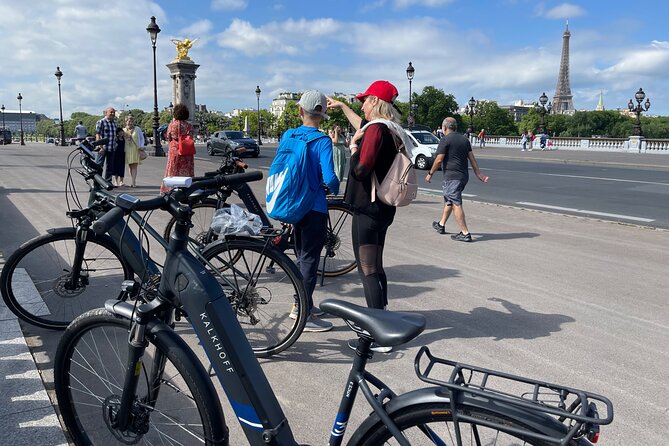
- Central Paris in one ride: A tight loop that strings together Invalides, Concorde, the Champs-Élysées area, Arc de Triomphe, and a close Eiffel stop.
- Real-world comfort tools: E-bikes and helmets are provided, which makes the experience feel easier than biking everywhere on your own.
- Guides with names you’ll hear a lot: I kept seeing guide names like Kenza, Fadwa, George, Alex, Jack Knox, and Hugo praised for pacing and keeping things fun.
- Built for first-time orientation: You’ll come away with the layout of the city and how these monuments line up.
- Max 25 people: Big enough to feel social, small enough to actually hear your guide.
- Weather matters: The tour requires good weather, so you should be flexible if conditions aren’t great.
Why Paris Highlights Make More Sense by E-Bike
If you only have a short window in Paris, you face a classic problem: walking between major sights takes longer than you think, and public transport doesn’t always drop you exactly where you want to be. This tour solves that by doing the heavy lifting for you. In about 2.5 hours, you cover a serious chunk of central Paris, using an e-bike to keep the pace moving without making you feel wrecked.
I also like that this isn’t just “see the monuments, take the picture, leave.” The stops are brief, but the guide uses them as story stops—why a place matters, what was happening around it, and what to notice while you’re there. That kind of context is what makes the photos feel meaningful later, not random.
There’s another quiet win here: the route is designed for flow. You’re not bouncing around with long transfer gaps. You’re rolling from one iconic landmark to the next, with enough stops for pictures and enough riding time to keep momentum.
You can also read our reviews of more tours and experiences in Paris.

Meeting at 101 Av. de la Bourdonnais: Your First Quick Win
You start at 101 Av. de la Bourdonnais, 75007 Paris, and the tour ends back at the same meeting point. That matters more than it sounds. It means you avoid the “now what?” feeling that hits when a tour dumps you across town.
The area is well-connected to public transportation, which helps if you’re arriving from a hotel that isn’t walking distance to central sights. You’ll also get a mobile ticket, which is one less thing to manage in a city where you’ll already be juggling maps, tickets, and snack plans.
Because the tour is offered in English and runs as a small group (maximum 25), you should expect a guided experience that still feels personal. It’s not a giant bus tour where everyone disappears into their own head.
The Route: From Les Invalides to Eiffel Tower Without the “Where Do We Go Next?” Feeling
This is basically a highlights loop designed for orientation. You begin with Les Invalides, then work your way toward some of the Seine’s most photogenic spots and the famous grand public spaces along the way.
The big practical benefit is that you’ll see how these landmarks relate to each other. Even when you’re not going into museums or towers (and most stop times are for quick photos and stories), the layout becomes clearer. That makes it easier to plan the rest of your trip after this ride—especially if you want to return later on foot or by metro.
Here’s what the ride is doing for you, step by step:
- You get history and context at the stops, not only on arrival photos.
- You cover long-distance-looking sights quickly, thanks to the e-bike.
- You end near the Eiffel area, so you leave with that iconic image already locked in.
And yes, it’s quick. Each stop is short—think around five minutes at most of the major photo points—so if you want deep museum time, you’ll still need separate plans. But for getting oriented and capturing the “I’m really in Paris” moments, the structure makes sense.
Stop-by-Stop: Invalides, Pont Alexandre III, Petit Palais, and Grand Palais
Les Invalides: Napoleon’s Setting and Louis XIV’s Purpose
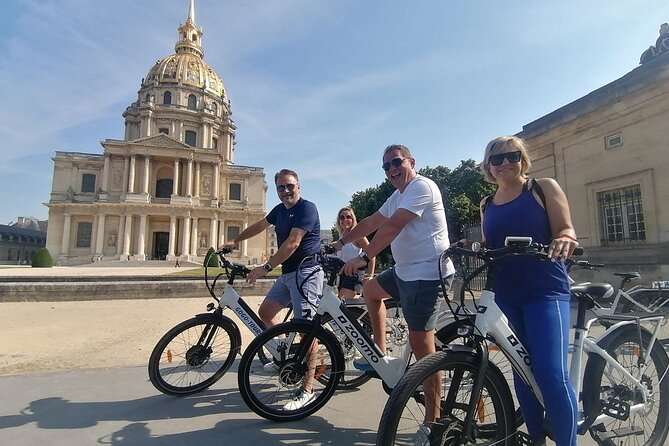
Your first stop is Les Invalides, the Military Museum and the tomb area associated with Napoleon. What makes this place stand out is the dual identity: it’s both a military monument and a historical anchor. The complex was commissioned in 1670 by Louis XIV to provide housing and care for wounded soldiers, so it’s not just grand architecture—it’s a built-in reminder of how seriously France treated military life and sacrifice.
What you should do here: take your photos from a couple angles if you can, and listen for the “why this exists” explanation. The facts make the building more than a backdrop.
One note: admission for this stop is listed as free, and the stop is short, so don’t expect to wander the museum galleries in this time window.


Pont Alexandre III: A World Fair Bridge That Looks Like a Showpiece
Next comes Pont Alexandre III. This is one of those bridges where your brain says, okay, Paris is real. It was built for the World Fair in Paris and is considered among the city’s most beautiful bridges.
The quick stop is ideal because the bridge’s details reward a slow look—but you don’t have to be slow to catch the big-picture drama. You’ll get the story and enough time for photos without turning the tour into a long waiting game.
Petit Palais and Grand Palais: The 1900 Universal Exhibition Twin Acts
Then you hit the pair that Paris uses as a visual shortcut to “major art and big events.” Petit Palais was built for the 1900 Universal Exhibition, like its neighbor the Grand Palais, and later became a museum in 1902.
Then you roll into Grand Palais, another universal-exhibition icon dedicated to French art. This area is where many first-time visitors realize something: Paris loves a grand entrance. These buildings are designed to impress, and the 1900 context helps you understand why.
Practical drawback to know: both stops are fast. If you’re hoping to see interior exhibits, this ride won’t replace that plan.
Concorde to Arc de Triomphe: The Grand Axis at Bike Speed
Place de la Concorde: Big Square, Big Layers
Place de la Concorde sits between the Champs-Élysées and the Tuileries Gardens. It’s also one of Paris’s most evocative public spaces, partly because it has a history that feels heavy even when you’re just passing through for photos. The square is described as the largest in Paris.
In a short stop, the guide’s job is key: they’ll help you notice what you’d miss if you just glanced and moved on. This is a great example of why a guided “five-minute stop” can still be useful.
Champs-Élysées and the Arc de Triomphe: Monumental Memory
You then pass by the Champs-Élysées area. The story here is tied to major French rulers and empire-era plans: Louis XIV commissioned the avenue’s creation, and Napoleon ordered the construction of the Arc de Triomphe after Europe’s conquests.
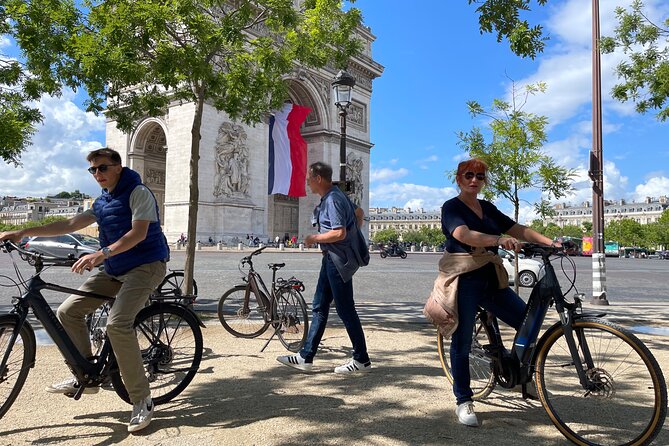
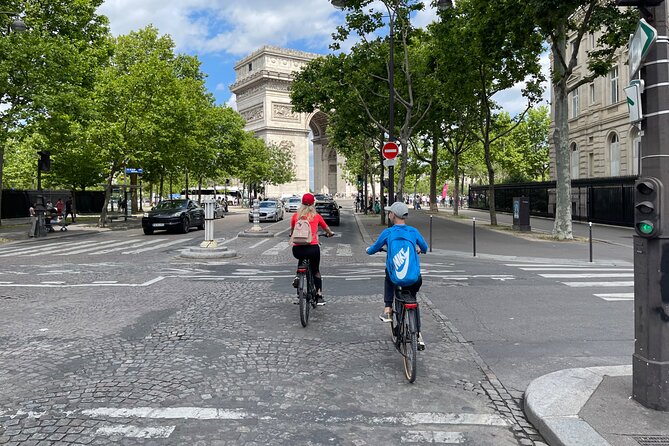
Finally, you arrive at the Arc de Triomphe, whose purpose was to preserve memory of French army victories. The first stone was laid August 15, 1806, and the monument was finished about 30 years later.
If you’ve only ever seen the Arc from afar, this stop is worth it. Seeing it up close (and hearing why it was built) changes how you read the monument. It’s not only a photo target; it’s a deliberate message in stone.
Eiffel Tower Close-Up Stop: What You Can Do and What You Can’t
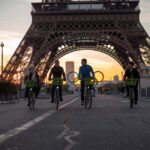
The ride ends with an Eiffel Tower stop. The tower is described as a symbol of France for decades, and its original goal in 1889 was meant to be temporary. The story also notes that Parisians didn’t instantly love it—which makes you appreciate how iconic things often start.
Important planning point: the Eiffel Tower admission ticket is not included. So while you’ll get a close-up stop and a chance for pictures, if you want to go up or enter paid areas, you’ll need to arrange that separately.
This works well for most people because the tour time is limited. You get the moment, then you decide what level of effort you want next.
How Safe It Feels in Real Paris Traffic
You’re not riding on a calm nature trail. You’ll cycle in central Paris, and that means traffic. The good news is that the e-bike helps you stay steady and reduces strain, and helmets are provided. The guide also plays a huge role in keeping the ride smooth.
Based on the consistent theme in the guide praise, they focus on pacing and safety. I’d expect you to stop, regroup, and follow instructions. Still, you should be realistic: bike lanes and crossings aren’t like home, and Paris can be intense.
My practical tip: arrive with a mindset of calm attention. If you’re nervous, tell the guide early. The pace can matter a lot when you’re riding through a mix of vehicles and pedestrians.
Also note that weather can affect operations. The tour requires good weather, and poor conditions can lead to rescheduling or a refund offer.
The Guide Difference: When Stories Make the Ride Fun
This tour’s reviews consistently highlight the guide quality—especially their historical explanations and the way they manage different comfort levels on bikes.
Names that came up often include Kenza, Fadwa, George, Alex, Jack Knox, Hugo, Arthur, Daniel, and Ziggi. The common threads are:
- clear, friendly communication
- a pace that doesn’t leave half the group behind
- patience when someone’s bike has a hiccup or someone needs a moment
That last part matters. E-bikes are designed to be user-friendly, but bikes can still need small adjustments, and roads can have closures. When those things happen, it’s the guide who turns a potential problem into a “no big deal” moment.
If you’re visiting with kids or teens, this is also a strong pattern. Several guides were praised for keeping the experience engaging for younger riders, which is not easy on a short time schedule.
E-Bikes, Helmets, and Pacing for Different Riders
You’ll have access to the e-bike and helmet. That’s the core comfort setup. E-bikes help you keep up without burning out your legs, which means you can stay focused on watching the city and listening to the guide.
Pacing is built around quick stops and continuous movement. With that structure, people who like a “see a lot, learn a bit, don’t overthink it” style usually feel happy with the experience. People who want long lingering time at monuments may feel slightly rushed because the stops are short.
If you’re riding with someone less confident on bikes, the small-group size helps. The ride isn’t split into sub-tours, but it also isn’t chaotic. You’ll still be guided as a group.
Price and Value: Is $78.61 a Smart Shortcut?
At $78.61 per person for about 2.5 hours, this isn’t a budget-only activity. But it’s also not just “rent a bike and hope you know where to go.” What you’re paying for is:
- professional guidance and route management
- safety basics (helmets)
- e-bike assistance so you can cover more ground than walking
- a structured set of photo-and-story stops focused on central Paris
If you’re comparing this to doing it on your own, the biggest hidden cost is your time and stress. Finding meeting spots, managing navigation, and figuring out where to safely stop for photos takes effort. Here, you get a plan and a guide who keeps it moving.
Also, the tour popularity is a clue: it’s often booked about 43 days in advance on average. That suggests people find it useful as an early trip orientation. If you can, booking ahead increases your chances of good timing.
One extra value angle: there’s an upgrade option for a private tour if you want the route customized more tightly to your interests. That’s a nice option if you’re traveling as a couple or family that doesn’t want to share the pace.
Who This Tour Fits Best (and Who Should Rethink It)
This is a great fit if you:
- want a high-impact Paris overview in a short amount of time
- like learning the story behind major landmarks as you see them
- prefer active sightseeing without the strain of nonstop walking
- want a small-group experience with professional guidance
It may be less ideal if you:
- strongly dislike riding in traffic or on busy streets
- need long stops at monuments and museums (this is short photo-and-context time)
- are counting on weather to stay perfect every day (the tour requires good weather)
Should You Book This Paris E-Bike Highlights Tour?
If you want a simple way to get your bearings fast and see the big Paris icons in one go, I’d say this is worth your time. The e-bike setup, helmet provision, short guided stops with context, and consistently praised guides like Kenza, Fadwa, George, Alex, and Jack Knox make it feel like a practical, fun way to spend a morning or afternoon.
My main caution is the one you should take seriously: you’ll ride in real city conditions. If that sounds stressful, you’ll need to decide honestly whether you can handle bike traffic with guidance.
If your goal is a guided “highlights loop” that helps you plan the rest of your trip, book it early and go with a calm, focused attitude.