REVIEW · NEW ORLEANS
Tale of Two Cities: Uptown Bike Tour in New Orleans
Book on Viator →Operated by Flambeaux Bicycle Tours · Bookable on Viator
A bike ride makes New Orleans feel effortless. You’ll love the Garden District route for its easy, flat ride, and the way your guide ties streets to Jazz origins as you roll from the Perdido-Rampart corridor toward uptown. One thing to consider: this is real biking time. You’ll need solid comfort on a bike saddle, and flip-flops are a no-go.
This tour is built for covering more ground than a walking route without the usual traffic and parking stress. It also runs with a small max group size of 10, so you’re not stuck behind a slow-moving crowd on narrow streets. The ride stays fun and manageable because it’s designed for a broad range of riders, as long as you meet the minimum age and fitness expectations.
In This Review
- Key things I’d circle before you go
- Getting Started at 626 N Rampart St (and Why the Timing Matters)
- Why This Uptown Bike Route Beats a Walking Tour
- Stop 1: Flambeaux Bicycle Tours to the Perdido-Rampart Jazz Origins
- Stop 2: Garden District Architecture and the Louisiana Purchase Chapter
- Stop 3: Lafayette Cemetery No. 1 Outside the Gates (What You Still Learn)
- Stop 4: Lafayette Square and the Former City of Lafayette
- Bikes, Helmets, and Bottled Water: What’s Included
- Price and Value: What $55 Buys You in Real Time
- Safety and Comfort: What to Expect From the Ride
- Who Should Book This Uptown Bike Tour
- Should You Book This Tour?
- FAQ
- Where does the tour start?
- What time does the tour begin?
- How long is the Uptown Bike Tour?
- How much does it cost?
- What’s included in the price?
- Do I need to rent a bike or helmet?
- Is food included?
- Is Lafayette Cemetery No. 1 part of the tour?
- What are the age and height requirements?
- What if I need to cancel?
Key things I’d circle before you go
- Garden District by bike, not on foot: You get pace and perspective in the same 3 hours.
- Perdido-Rampart corridor Jazz context: Your guide sets the scene with stories tied to this area.
- Lafayette Cemetery No. 1 stop without entry: It’s outside the gates due to repairs, with explanations on-site.
- Lafayette Square as a quick history lesson: You learn how the former city’s public space still matters.
- Small group size (10 max): Easier crowd flow and more guide attention.
- Helmet and bottled water included: Fewer extras to plan, right from the start.
Getting Started at 626 N Rampart St (and Why the Timing Matters)
Your tour meets at 626 N Rampart St, New Orleans, and it ends right back where you started. The start time is 10:00 am, and the whole experience runs about 3 hours. It’s also set up with a mobile ticket, so you’re not juggling paper paperwork.
No hotel pickup is listed, so you’ll want to plan to get yourself to the meeting point. If you’re coming by public transportation, you’re in a decent spot since the meeting location is noted as being near it. Driving is doable too: the guidance for parking is to use the Basin Lot at 1205 St. Louis St for the best rates in the French Quarter area.
This matters because you don’t spend your morning waiting for a van or negotiating parking. You start riding, then you’re back in the neighborhood you began in.
You can also read our reviews of more tours and experiences in New Orleans.


Why This Uptown Bike Route Beats a Walking Tour
The main advantage is simple: you cover more ground without feeling rushed. On foot, you can spend a lot of time doing slow crossings and regrouping. On a bike tour like this, you keep momentum, so the stops feel purposeful instead of scattered.
The terrain is a big reason people enjoy it. The tour is described as flat terrain, which is exactly what you want when your goal is fun and stories, not a leg workout. Still, the tour isn’t for people who want to coast through with zero physical effort. The requirements ask for a strong physical fitness level, plus minimum height and age.
Two practical notes that can make or break your day:
- Minimum age is 13.
- You must be over 4’11”.
And please take the footwear warning seriously: wearing flip flops/slippers while riding is hazardous and highly discouraged.
Stop 1: Flambeaux Bicycle Tours to the Perdido-Rampart Jazz Origins
The first stop is at Flambeaux Bicycle Tours at the French Quarter location. From there, the ride heads toward the area tied to the former city of Lafayette, with stops along the Perdido-Rampart corridor.
This is where the tour starts doing something that walking tours often miss: it connects a story to the route itself. Your guide explains the origins of Jazz linked to this corridor. You’re not just hearing a general overview. You’re moving through the city while the guide points out why this stretch matters.
After that Jazz-focused segment, you continue toward the Garden District, and the theme shifts to the people who arrived later. The tour highlights the American settlers who came to New Orleans after the Louisiana Purchase. That theme matters because the Garden District isn’t just a backdrop—it reflects shifts in who lived where and why.
Time-wise, this is a shorter segment (about 10 minutes for the first stop), so it works well as a warm-up. You get oriented fast, then you’re ready for the longer Garden District portion.
Stop 2: Garden District Architecture and the Louisiana Purchase Chapter
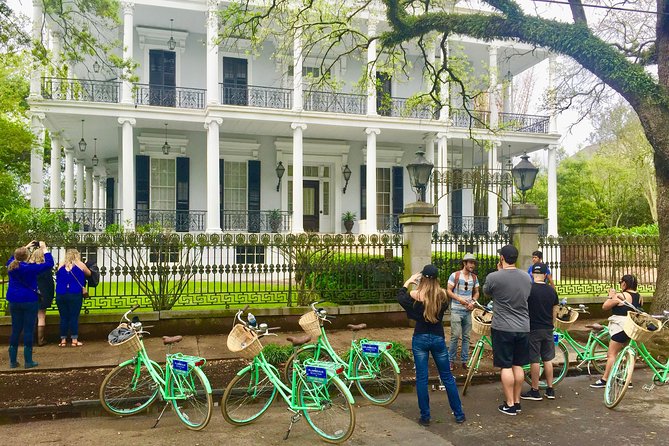
This is the heart of the tour: about 1 hour spent in the Garden District. The focus is the neighborhood’s antebellum architecture, and the way the guide connects the built environment to the people who shaped it.
If you like history but you don’t want a museum-style lecture, this part usually clicks. You’re riding at a steady pace, and the guide can point out features as you pass them. The stories aren’t trapped inside one building—you see how the neighborhood reads as a whole.
The guide also keeps the narrative tied to the “why” behind the area. After the Louisiana Purchase, American settlers moved into the city, and that’s the thread your tour uses to frame what you’re seeing. You’ll likely come away with a better sense of how the Garden District became what it is, not just a list of dates.
One practical upside: because the ride is flat and fun, you can pay attention without fighting uphill strain. That makes it easier to enjoy the architecture and not just survive the ride.
Stop 3: Lafayette Cemetery No. 1 Outside the Gates (What You Still Learn)
Here’s the reality check: Lafayette Cemetery No. 1 is closed for repair. The tour still includes the stop, but you’ll view it outside the gates.
That could sound like a downgrade, but it doesn’t have to be. The tour is still set up with a purpose at this point. Your guide explains the burial process as you stop there. Even without entry, you can get the context that helps cemeteries make sense as a cultural system rather than just a photo stop.
If your main goal is respectful understanding—what makes this type of cemetery different and how burial works—this approach can actually be a win. You’re not rushing in and out. You’re stopping in place long enough to absorb the explanation.
Time at this stop is about 10 minutes, so it stays part of the ride’s flow instead of turning into a long detour. Tickets are listed as free, but the real “ticket” here is the guide’s explanation.






Stop 4: Lafayette Square and the Former City of Lafayette
The last stop is Lafayette Square, about 10 minutes. This segment is focused on the square itself—its role as the public square of the former city of Lafayette.
This stop works best when you’ve already heard the earlier Lafayette references. By now, the tour has used the same umbrella theme—how the former Lafayette identity shows up around you. Lafayette Square becomes the “place where things happen” part of the story, not just a name you hear.
If you like the kind of history that links maps to meaning, this is a satisfying finish. You’re looking at a public space and learning what it was meant to do, which helps you understand why it still matters today.
Bikes, Helmets, and Bottled Water: What’s Included
Good news up front: you don’t need to deal with bike rental logistics. The tour includes:
- Use of bicycle
- Use of helmet
- Professional guide
- Bottled water
That’s a strong value bundle for a 3-hour outing. You can show up prepared without adding extra errands, and helmet inclusion is a big deal for comfort and safety on city streets.
Food is the one missing piece. It’s listed as not included unless specified. So plan to eat before or after. The bottled water included is helpful, but don’t assume this becomes a full meal break in the middle of the tour.
Price and Value: What $55 Buys You in Real Time
At $55 per person for about 3 hours, you’re paying for more than just “being outside.” You’re paying for:
- a guided route with historical storytelling,
- bike and helmet included,
- and small-group pacing designed to keep you moving.
This is also the kind of price that tends to work well when you’re short on time. New Orleans can eat hours with lines, walking detours, and transport juggling. This tour takes a different approach: it keeps you on a bike through the neighborhoods that matter most to the day’s stories.
One extra clue about value: the average booking window is 17 days in advance, which suggests people plan this as a go-to activity rather than a last-minute gamble. If you know you want it, booking ahead is smart.
Safety and Comfort: What to Expect From the Ride
The tour is described as flat and easy to enjoy, but the practical requirements are still real. You should go in with a strong physical fitness level and meet the height and age minimums.
Also plan to ride correctly. The guidance against flip-flops isn’t just fussiness—slippers can slip off pedals or don’t give you stable foot contact. Closed, secure footwear will make the ride smoother and more comfortable.
On the human side, the tour stands out for guide care and comfort. Several top-rated experiences highlight guides who kept people feeling safe around more trafficked stretches and used extra caution when needed. Names that come up strongly include Barrett, Eric, and Jonathan, each noted for friendly, story-driven hosting and careful riding habits.
Who Should Book This Uptown Bike Tour
This is a great match if you:
- want an efficient way to experience the Garden District,
- enjoy history when it’s told in a story style while you move,
- want to skip the stress of traffic and parking,
- and like the idea of a guided route instead of figuring everything out alone.
It’s less ideal if you:
- want to spend a long time inside Lafayette Cemetery No. 1. The stop happens outside because it’s closed for repairs.
- have a hard time meeting the biking expectations (minimum age, height, and fitness requirements).
- plan to ride in flip-flops or slippers.
If you’re traveling with a group and want a shared, high-energy activity that still feels educational, this format usually lands well.
Should You Book This Tour?
I think this one earns its place in an Uptown-focused day. The combination of bike + helmet included, a small group, and a route that connects the Perdido-Rampart corridor to the Garden District, then lands at Lafayette Cemetery No. 1 (outside) and Lafayette Square makes it feel like a complete, coherent story in just three hours.
Book it if you can comfortably meet the physical requirements and you’d rather ride through neighborhoods than walk them slowly. Skip it if your top priority is cemetery entry or you’re not ready for a steady bike outing.
FAQ
Where does the tour start?
The tour starts at 626 N Rampart St, New Orleans, LA 70116. It also ends back at the same meeting point.
What time does the tour begin?
The start time is 10:00 am.
How long is the Uptown Bike Tour?
The tour lasts about 3 hours.
How much does it cost?
The price is $55.00 per person.
What’s included in the price?
It includes a professional guide, use of bicycle, use of helmet, and bottled water.
Do I need to rent a bike or helmet?
No. Bike rental and a helmet are included, so you do not need to rent them separately.
Is food included?
Food is not included unless it’s specifically stated; bottled water is included.
Is Lafayette Cemetery No. 1 part of the tour?
Yes, there is a stop at Lafayette Cemetery No. 1, but it will be outside the gates because it’s closed for repairs. The guide explains the burial process there.
What are the age and height requirements?
The minimum age is 13 years, and all participants must be over 4’11”.
What if I need to cancel?
You can cancel for a full refund as long as you cancel at least 24 hours before the experience’s start time.