REVIEW · TOKYO
Tokyo Deep Inside Cycle Tour~3 Hours E Bike Tour around Tokyo
Book on Viator →Operated by TOKYO ACTIVE TOURS · Bookable on Viator
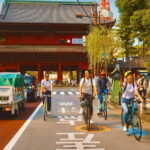
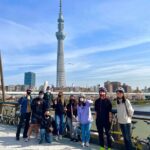
Tokyo on an e-bike feels like time travel. This 3-hour guided ride threads through old Edo streets and major modern landmarks, so you get the big picture of how Tokyo became what it is now—without getting lost.
I especially like the easy, assisted e-bike setup for riders of different experience levels, and I also like the built-in traditional snack break that keeps the energy up without turning the tour into a long food stop.
One thing to consider: the ride has a firm height rule (under 145 cm isn’t allowed), and the pace depends on small-group comfort since it’s a shared tour.
In This Review
- Key highlights you’ll actually use
- Marunouchi start: a 3-hour circuit that keeps your feet fresh
- Tokyo Station to Kanda Bridge Gate: start where Tokyo reinvented itself
- Kanda streets and Akihabara edges: where everyday culture meets modern change
- Hijiribashi to taiyaki to Jinbocho: a snack-led reset and a book-lover’s detour
- Yasukuni torii and Edo Castle sites: big gates, big meaning
- Marunouchi finish and the art stop: a calm wrap-up
- Why this e-bike route is the right Tokyo pace
- Price check: what $83.23 buys you (and what it doesn’t)
- Who should book, and who should skip
- Should you book Tokyo Deep Inside Cycle Tour?
- FAQ
- How long is the Tokyo Deep Inside Cycle Tour?
- What is the price per person?
- What’s included in the tour?
- What should I bring since bottled water isn’t included?
- Where do I meet, and when does it start?
- Is this tour suitable for beginners?
- Are there restrictions on height?
Key highlights you’ll actually use
- E-bikes for nearly everyone: low-effort cycling with a guide handling the flow
- Old-to-new Tokyo storyline from Edo Castle sites to today’s city blocks
- Taiyaki snack included with anko (red bean paste) or cream choice
- Small group size (up to 4) so you’re not stuck behind a crowd
- Route built around major landmarks like Tokyo Station, Kanda Shrines, Yasukuni, and the Imperial Palace perimeter
Marunouchi start: a 3-hour circuit that keeps your feet fresh
This tour is built for the “I walked a lot yesterday” crowd. It runs for about 3 hours, starts at 1:00 pm, and caps at 4 travelers, which matters more than it sounds. With a smaller group, the guide can slow down when traffic or comfort needs it, and you spend more time looking at Tokyo instead of negotiating lanes.
You’ll meet at the JTB Marunouchi Store at Marunouchi Eiraku Building (it’s connected to Tokyo Station via the Marunouchi area). The exact meetup point is listed as about a 1-minute walk from the Marunouchi South Exit of JR Tokyo Station, with easy connections to nearby subway lines.
You’ll get the essentials on site: an e-bike, a helmet, and bicycle insurance is included in the price. Bring your own water if you want it—bottled water isn’t included—because you’ll likely want to sip when you’re out and warm-wheeling between stops.
You can also read our reviews of more tours and experiences in Tokyo.

Tokyo Station to Kanda Bridge Gate: start where Tokyo reinvented itself
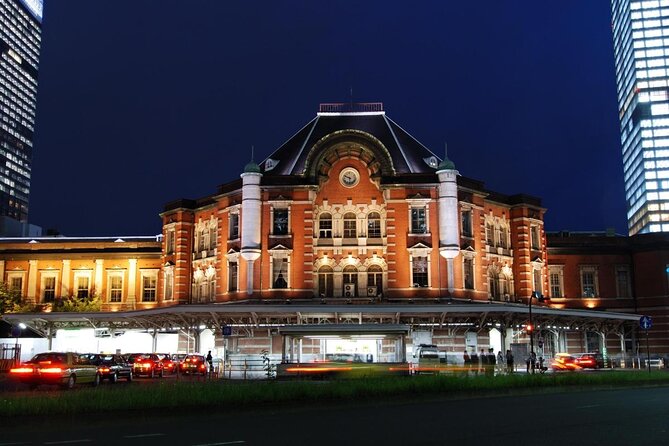
The ride begins right in front of Tokyo Central Railway Station, and that choice is smart. Tokyo Station isn’t just a landmark; it’s a reference point for how the city grew and reshaped land that used to be different. Even if you don’t know Edo history yet, the guide’s explanation helps you see Tokyo as layers, not just skyline photos.
From there, you head toward the remains of the Kanda Bridge Gate stone wall. This area ties into the Edo town that developed along the Nihonbashi River, which is one of those Tokyo details that usually feels abstract until someone points at the exact place and explains why it mattered.
Two practical things I’d plan for here:
- Expect short explanation stops, not long museum time.
- Keep your camera ready—stone walls, bridges, and river-adjacent areas have that “small size, big story” feel.
Kanda streets and Akihabara edges: where everyday culture meets modern change
Next comes Kanda Matsuya, a neighborhood framed as a place where the culture of ordinary people still has a hold on the area. That’s the kind of phrasing that could sound vague, but on this route it translates into the feel of moving through narrower alleys and older streets instead of only gliding past postcard views.
Then you hit Akihabara, which the tour presents as a lesson in Tokyo’s ability to change with the times. Akihabara’s modern identity has deep roots, including its postwar evolution—so the guide’s context helps you understand why the area looks the way it does today, even if you’re not shopping for electronics or anime.
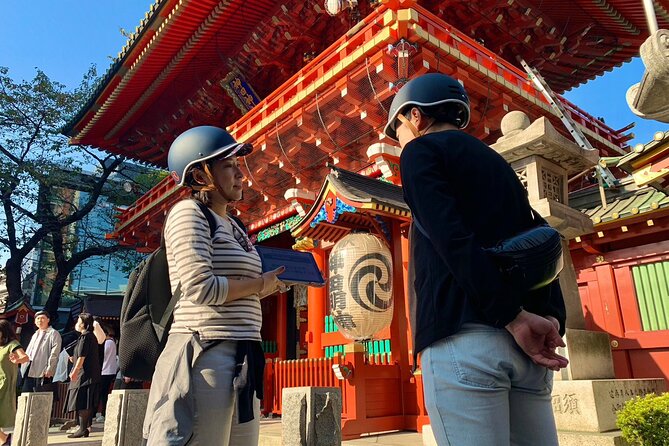
After that, you visit Kanda Shrine (Kanda Myojin). This is one of the stops where you get the clearest historical anchoring: the shrine is described as the chief Shinto shrine of Edo, and you’ll learn about Edo-period shrine culture and the Kanda Festival. There’s also a souvenir shop stop included, so you can pick up a small memento without scrambling later.
In plain terms: this section is where the tour balances “movement” and “meaning.” You’re cycling, but the guide connects what you’re seeing to how Edo life worked.
Hijiribashi to taiyaki to Jinbocho: a snack-led reset and a book-lover’s detour
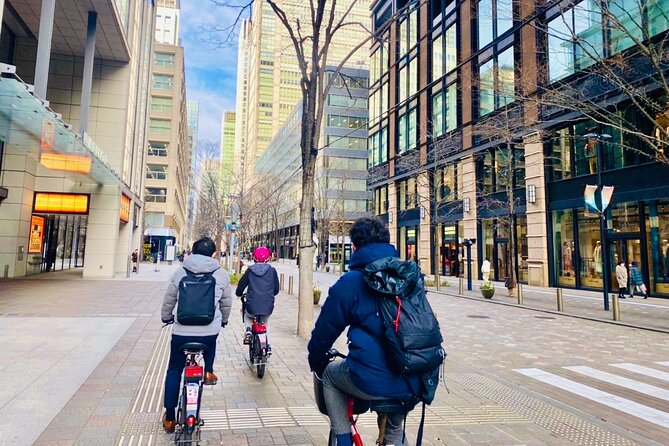
A quick change of rhythm follows at Hijiribashi Bridge, where you get a view looking down toward Ochanomizu Station. The tour frames Ochanomizu as a student town with history, and the bridge viewpoint gives you a sense of place without turning the stop into a long break.
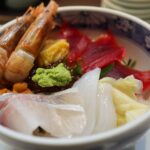
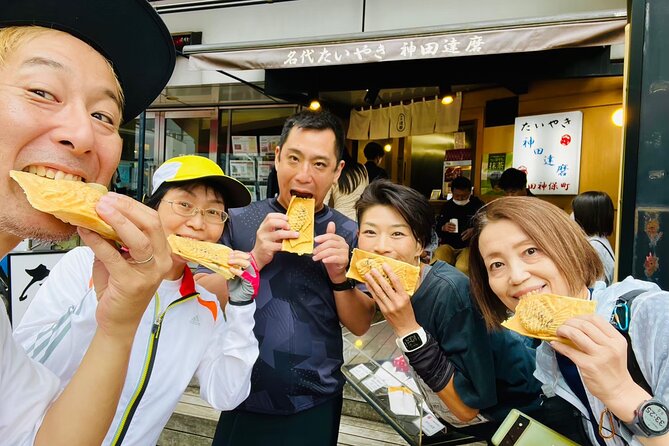
Then you get the included snack stop: Kanda Daruma is where you try taiyaki. You can choose anko (red bean paste) or cream. This snack matters because it’s timed like a reset, not just an add-on. After a few hours of cycling and story stops, it keeps energy up without derailing your schedule.
Next is Kanda Jinbocho, a pass-by through the antiquarian bookstore district that’s described as one of the largest in the world. You don’t stay long—this is mainly a ride-through moment—but it’s an easy way to see Tokyo’s book culture in a real urban setting rather than a curated storefront list.
If you’re the type who loves strolling through neighborhoods later, this section is a good prompt: you’ll likely remember how Jinbocho feels and want to return on foot.
Yasukuni torii and Edo Castle sites: big gates, big meaning
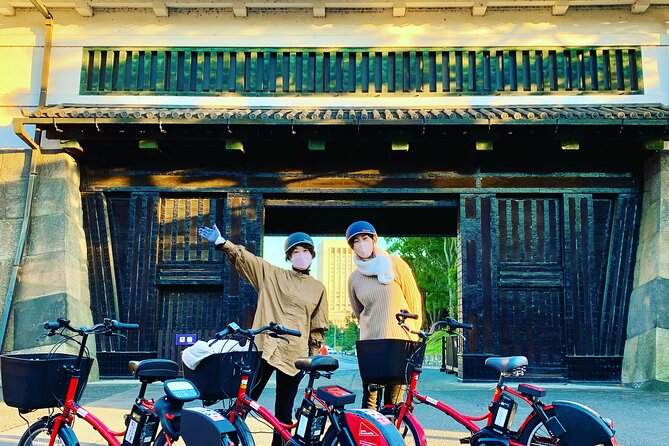
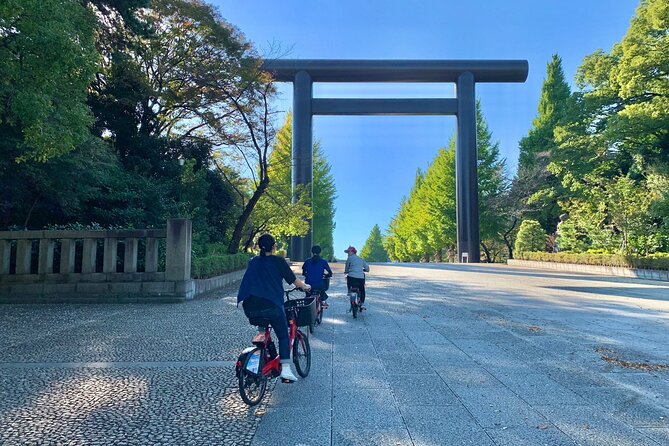
This tour leans into iconic Tokyo religious spaces. You ride under the torii at Yasukuni Shrine, described as one of the highest and largest torii in Japan. That’s the kind of detail that changes how a torii looks once you understand it’s not just decoration—it’s a visual marker of a place with scale and history.
There’s also a restroom break here, which is quietly helpful on a short tour. You’re not stuck planning your timing around shrine facilities later.
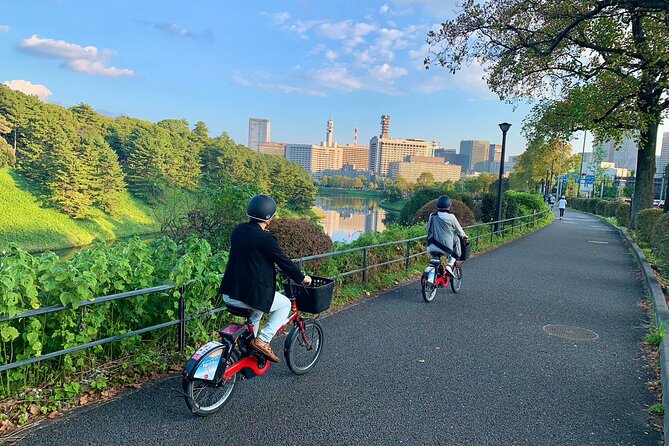
After Yasukuni, you move into the Kitanomaru Park area, connected to the Edo Castle’s Kitanomaru. Even with limited time, the tour treats this like a key historical site, with a ride-through of the area and a visit around landmarks including the Nippon Budokan.
Finally, you reach the Imperial Palace area, explained as the original site of Edo Castle. The guide also covers the cultural shift away from the old “chonmage samurai” look—basically, how Japanese identity and daily life changed as the city transformed. You pass through the outer-perimeter area around the Sakuradamon Gate, described as the largest gate in the Imperial Palace.
This is a strong stretch for first-timers because you’re seeing Tokyo’s “center of history” without needing to understand every political term. The guide’s pacing keeps it readable and not lecture-heavy.



Marunouchi finish and the art stop: a calm wrap-up
You end at Marunouchi Building, where you return the bicycles. From there, you walk inside to view an art exhibit with the theme Time and Memory.
This final stop gives the tour a softer landing. Instead of rushing immediately into more nightlife or shopping, you get a structured last moment that matches the tour’s core idea: Tokyo as a blend of eras. If you’re traveling with people who prefer a little variety beyond landmarks, this wrap-up tends to land well.
Why this e-bike route is the right Tokyo pace
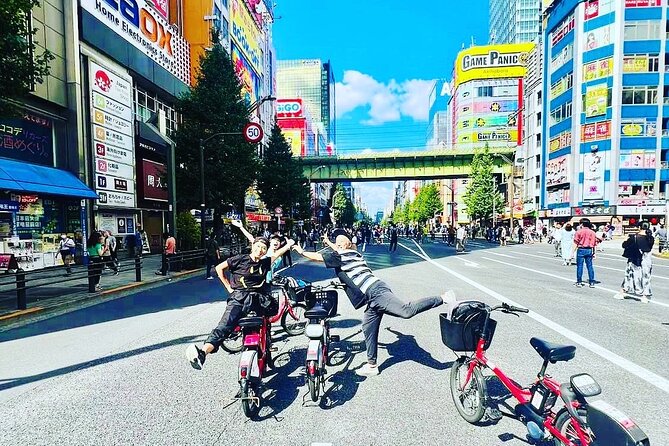
Here’s the big value of an e-bike tour in Tokyo: it solves two common problems at once—fatigue and direction. Tokyo looks walkable on paper, but in real life you’re crossing crowded areas, dodging signals, and losing time to train transfers. On an e-bike, you keep moving while still getting close to streets and neighborhoods.
The tour also includes a helpful rhythm of short, guided stops, so you’re not forced into a constant “look and listen” mode. In this format, I like that you can enjoy the ride while still learning enough history to connect places. One practical detail from past riders: a typical route covered about 6.8 miles (over 10 km), with people describing it as a welcome break from walking 10,000+ steps.
Safety-wise, the guide approach seems cautious and guest-focused. Past participants even described a patient, safety-first style from guides such as Micki (mentioned by name) and Tussie (also mentioned). I’d still treat this like real cycling: wear shoes you feel steady in, and follow the guide’s instructions for traffic situations.
Price check: what $83.23 buys you (and what it doesn’t)
At $83.23 per person for roughly 3 hours, this price is easier to judge if you list what’s included. You’re getting:
- E-bike use
- Helmet
- Taiyaki snack
- Bicycle insurance fee
That’s a lot of “tour-adjacent costs” removed from your day. The main thing not included is bottled water, so budget a small amount for that if you’ll want it.
I also think the small-group setup helps justify the cost. A shared tour with up to 4 riders can feel less like a production line and more like a guided neighborhood circuit with faster pacing than walking. If you like the idea of seeing multiple areas in a half-day but want the guide to prevent time-wasting, this is the kind of deal that often feels fair.
Who should book, and who should skip
This tour fits best if you:
- want a guided introduction to central Tokyo
- like history but don’t want long museum marathons
- want a more active day than a bus tour without feeling like you must grind through thousands of steps
- enjoy short photo moments and walking breaks built into a cycling plan
It may not fit as well if you:
- need to avoid cycling due to personal mobility limits (even with e-bike assistance)
- fall under the 145 cm height restriction
- strongly prefer self-paced travel with zero structure (this is a guided route with timed stops)
- need a fully flexible day regardless of weather, since the tour requires good conditions and has a rain-day option
If you’re the type who travels with a knee, an ankle, or any comfort concerns, this kind of e-bike format is often more manageable than standard bicycle or long walking. Just make sure you can ride safely and comfortably from stop to stop.
Should you book Tokyo Deep Inside Cycle Tour?
Book it if you want a smart first look at Tokyo’s center: Tokyo Station → Kanda → Akihabara → shrines → Edo Castle grounds → Imperial Palace perimeter, all in about 3 hours. The included taiyaki, the small group size, and the guide-led explanations make it feel like more than just transportation.
Skip it if height limits affect you, if cycling itself is a problem, or if you need a plan that never changes with weather. Also note that you’ll be relying on a guide-managed schedule—if you’re late and don’t coordinate ahead of time, it can mean the tour is canceled for you, with the day operating under a strict no-show approach.
If your Tokyo itinerary includes a lot of walking already, this tour is a nice way to get out, see meaningful places, and still keep your body happy. That balance is exactly where this e-bike circuit earns its keep.
FAQ
How long is the Tokyo Deep Inside Cycle Tour?
The tour lasts about 3 hours.
What is the price per person?
The price is $83.23 per person.
What’s included in the tour?
You’ll get e-bike use, a bicycle helmet, taiyaki snack, and a bicycle insurance fee.
What should I bring since bottled water isn’t included?
The tour does not include bottled water, so it’s a good idea to bring your own beverage if you want one during the ride.
Where do I meet, and when does it start?
You meet at JTB Marunouchi Store in Marunouchi, with the location described as a 1-minute walk from Marunouchi South Exit of JR Tokyo Station. The start time is 1:00 pm.
Is this tour suitable for beginners?
Yes. The tour is described as being suitable for riders of all experience levels, and the guide adjusts pace if someone in the group isn’t accustomed to cycling.
Are there restrictions on height?
Yes. Participants under 145 cm in height are not allowed.